

A million people pressed a button that says “seems like AI slop.” That tells LinkedIn something about frustration. It does not tell a publisher which sentence, image, or idea failed.
LinkedIn AI slop now has a community-feedback signal with real scale. LinkedIn Chief Product Officer Hari Srinivasan wrote that more than one million people used the new feedback option during its first two weeks. He also said content LinkedIn classifies as AI slop was receiving 40% fewer views than it had a few weeks earlier.
Both numbers come from LinkedIn. The company has not published the denominator, classifier precision, false-positive rate, or a controlled study connecting reports to reach. That leaves publishers with a useful warning and a bad temptation: trying to reverse-engineer a detector that LinkedIn has not described.
I would take the opposite route. Make the post easier for a real person to trust. Specific experience, attributable evidence, original examples, and a claim you can defend will survive more feed changes than another trick for sounding less synthetic.
What LinkedIn actually announced
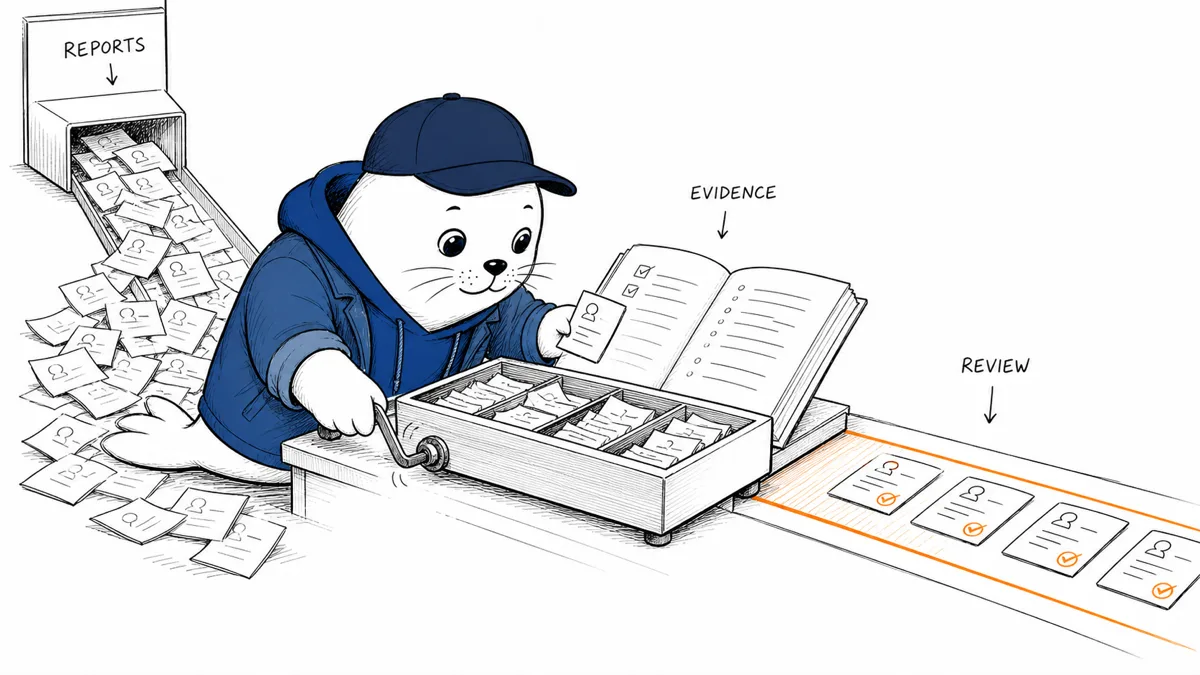
Srinivasan’s August 20 follow-up described three related changes. First, LinkedIn added “seems like AI slop” to the feedback menu. Second, it is adding Post Analytics messages when enough community feedback accumulates. Third, it is combining those reports with other quality signals rather than letting one click decide distribution.
That last detail matters. LinkedIn says no single report determines whether a post is shown less often, and it says safeguards are intended to limit coordinated abuse. A report is an input to a ranking system, not a public verdict on authorship.
The reported 40% view reduction also needs precise wording. It concerns content LinkedIn classifies as AI slop and compares current views with a point a few weeks earlier. It is not a claim that all AI-assisted posts lost 40%, that community reports caused the full change, or that any individual account should expect the same result.
One million clicks is attention data, not accuracy data
A million clicks sounds like an evaluation set. It is not one until LinkedIn tells us what was reported, who reviewed it, how agreement was measured, and how many reports were rejected or reversed. The same post can look lazy to one reader and efficiently summarized to another.
The missing denominator is especially important. One million reports across ten million viewed posts would describe a very different system from one million reports across ten billion views. LinkedIn has not supplied the number needed to calculate a report rate.
This is the same reason I was careful with YouTube’s AI detector after an original animation was reportedly flagged. Our review of the Kurzgesagt false-positive dispute focused on the appeal path, not on pretending a label could settle provenance. Community feedback can be useful while still being noisy.
The analytics warning could be more useful than the reach penalty
A private analytics message gives a publisher a chance to inspect the work. That is more actionable than discovering a week later that reach collapsed. The quality of the feature will depend on what the message explains and whether authors can contest obvious abuse or misclassification.
LinkedIn has not described those details publicly. For now, treat the message as a diagnostic lead. Look at the opening, the evidence, the examples, the comments, and the gap between what the post promised and what it delivered. Do not treat the warning as proof that AI wrote the post or that rewriting a few phrases will fix it.
A five-part test before you publish
- Name the observation. Replace broad claims with a result you saw, a decision you made, or a failure you can explain.
- Show the evidence. Link the primary source, include the relevant number with its conditions, or describe the test behind the conclusion.
- Add one example nobody else owns. A screenshot, calculation, customer question, rejected draft, or before-and-after decision is harder to mass-produce than a generic lesson.
- Cut the borrowed posture. Remove fake certainty, motivational padding, and confident conclusions that the evidence does not earn.
- Put a person behind the claim. The author should be able to answer a reasonable challenge in the comments without asking a model to invent the missing experience.
Our guide to content creation with AI makes the same distinction in workflow terms: use the model to organize and accelerate, then keep source checking, examples, editing, and judgment attached to the author.
What teams should measure instead of “human-sounding”
Detector evasion is a moving target because the platform can change the signal mix without telling you. Editorial quality is easier to inspect. Track saves, qualified replies, click-through to the evidence, corrections, hidden or deleted comments, and whether the post produces a useful conversation with the audience you intended to reach.
Also keep a small record of posts that receive the analytics warning. Compare topic, format, source density, originality, posting time, and audience response. Twenty of your own posts with consistent notes will teach you more about your publishing system than a viral list of forbidden phrases.
There is one uncomfortable possibility: a specific, sourced, genuinely useful post may still be reported because readers dislike the style or the argument. That is why LinkedIn’s anti-abuse controls and appeal behavior matter. Quality feedback is not the same thing as majority taste.
My verdict: use the flag as a review request
LinkedIn’s million-click milestone proves that readers wanted a way to object to low-value feed content. It does not prove the crowd can identify authorship, and it does not expose the ranking formula.
If the warning appears, review the post as if a sharp editor wrote “prove it” in the margin. Find the unsupported claim. Replace the interchangeable example. Add the source. If nothing is wrong, keep the evidence and watch the distribution rather than sanding the prose into a different kind of generic.
Read the source and inspect your own posts
Which recent post could you improve by adding one source or one example only you can provide?
Checked August 24, 2026. The one-million-click and 40% view figures are company-reported by LinkedIn. LinkedIn has not published the denominator, classifier accuracy, false-positive rate, or a causal experiment connecting reports to the full view change.