

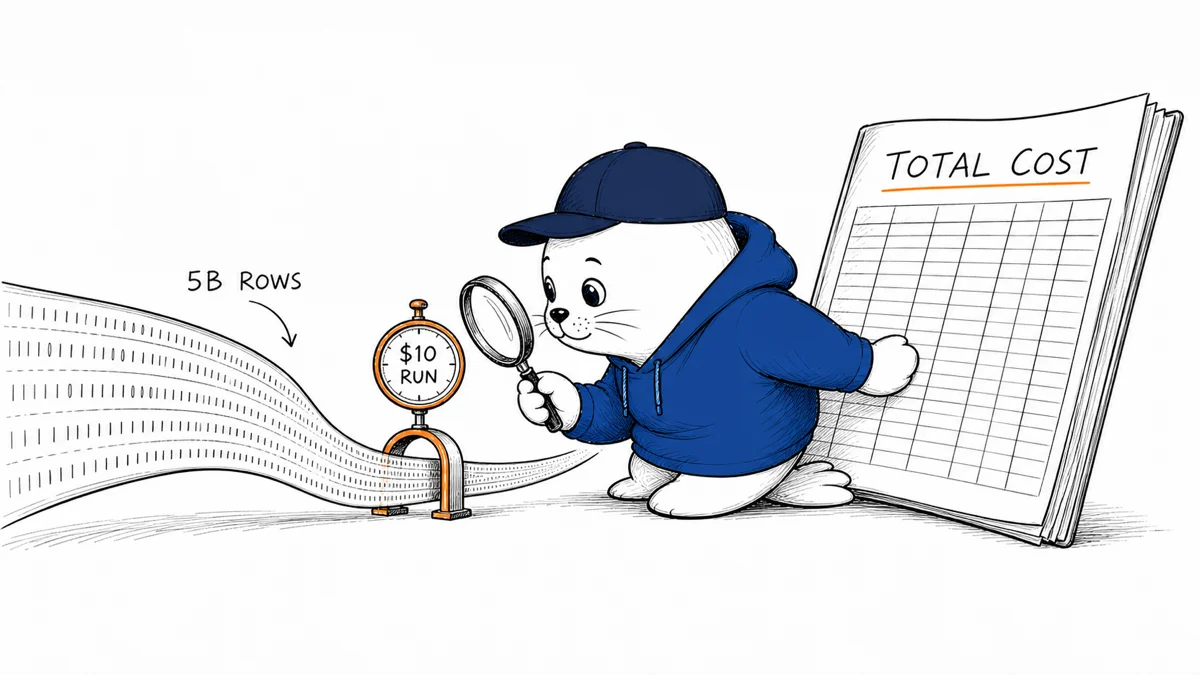
Aible says one BigQuery run processed five billion rows and tested ten million variable combinations for $10. That is impressive execution pricing. It is not the total cost of enterprise AI.
Aible BigQuery cost claims deserve attention because the published workload is unusually concrete: five billion data rows, ten million variable combinations, less than ten minutes, and a $10 query-execution bill. Google Cloud’s customer case also says Aible can run up to ten fine-tuned LoRA variants on one GPU and put production environments live in 15 minutes.
The responsible reading is narrower than the marketing headline. The $10 refers to serverless BigQuery execution for the described analytical workload. It does not include data preparation, storage, model inference, engineering, security review, evaluation, business-user time, or the cost of fixing a wrong decision.
What Google Cloud and Aible report
| Reported result | Published scope | What it does not establish |
|---|---|---|
| 5 billion rows | Data processed in the cited BigQuery workload | Dataset quality or business value |
| 10 million combinations | Variables evaluated during the run | That every combination was useful |
| Less than 10 minutes | Execution time for the described test | End-to-end project delivery time |
| Serverless query execution as described by Google Cloud | Total cost of ownership | |
| 222 agents in 90 minutes | A 36-person State of Nebraska team using prebuilt capabilities | 222 audited production systems |
Google Cloud also presents a "1,000x analytics efficiency" figure linked to joint white papers. Without one comparison table showing the baseline hardware, data, workload, accuracy target, and full cost boundary beside the new run, I would not convert that multiplier into a general promise. The five-billion-row workload is more useful because its units are visible.
Why the $10 figure can mislead a budget meeting
Serverless pricing can make a large analytical query inexpensive by charging only for the execution window. That is a real architectural advantage. A finance team can still misunderstand it if the number is repeated as "the AI project cost $10."
| Cost layer | Included in the published $10? | Evidence to collect |
|---|---|---|
| BigQuery execution | Yes, for the described run | Job id, bytes processed, duration, and billing export |
| Data cleaning and modeling | Not specified | Human hours, pipeline runs, and failed jobs |
| Model inference and GPU | Not specified | Tokens, accelerator time, and serving cost |
| Evaluation and review | Not specified | Test cases, reviewers, defects, and acceptance rate |
| Security and governance | Not specified | Access work, audit logs, red-team time, and approvals |
| Business change | Not specified | Training, process redesign, support, and measured KPI movement |
The table does not invalidate the $10 run. It protects it from being asked to answer a bigger question than the evidence supports.
The architecture keeps data near BigQuery
Google Cloud says Aible keeps enterprise data inside the customer’s BigQuery boundary and executes the analytical work there. The system uses Cloud Run for orchestration and moves a verified agent configuration from an air-gapped NVIDIA DGX Spark environment into Google Cloud.
That architecture reduces unnecessary data movement, which can lower both latency and exposure. It does not remove the need to review identities, permissions, logs, data retention, model inputs, tool access, and the path from an analytical answer to a consequential action.
Our AI agent containment review makes the relevant point: a prompt boundary is not an infrastructure boundary. Low-cost execution should make it easier to run more tests, not easier to skip controls.
Ten LoRA variants on one GPU changes the test loop
Aible says it can run up to ten fine-tuned LoRA variants concurrently on a single GPU. The practical value is not "ten models for free." It is the ability to compare specialized variants without assigning one full accelerator to each experiment.
That can shorten the path from an idea to an evidence-backed choice. The comparison still needs the same evaluation set, decision threshold, latency budget, and failure review. Running ten variants at once creates more outputs; it does not automatically create a better selection process.
222 agents in 90 minutes measures construction speed
Google Cloud says a 36-person Nebraska team, including interns, built 222 data-driven agents in 90 minutes. Dividing the total gives about 6.2 agents per person during the session. That is a calculation from the published figures, not a quality or productivity benchmark.
"Built" can cover a spectrum from configured prototype to production service. Before treating 222 as a deployment result, ask how many agents had distinct business owners, passed evaluation, received production permissions, were used after the workshop, changed a KPI, and remained supported a month later.
A replication checklist for builders
- Freeze the dataset, workload, and acceptance metric before the run.
- Export query ids, bytes processed, duration, and direct cloud charges.
- Record every cost outside the query window in a separate ledger.
- Compare at least one simpler baseline using the same accuracy requirement.
- Review wrong answers and business consequences, not only median latency.
- Repeat the workload after cache, concurrency, and data-volume changes.
- Track which prototypes reach recurring production use.
This is the same discipline founders need when pricing their own AI services. The meter should match the expensive primitive, and the total-cost ledger should capture the work the meter leaves outside.
My verdict: publish the run and the boundary
Aible’s BigQuery result is useful because it turns an abstract serverless claim into a workload with rows, combinations, time, and an execution charge. The number becomes less useful the moment it is presented as the price of enterprise AI.
Builders should copy the measurement style and improve the disclosure. Publish the direct run cost beside data work, inference, evaluation, security, human review, and business outcome. A cheap query is worth celebrating. A cheap query that leads to an expensive wrong decision is not.
Read the primary case study
- Read Google Cloud’s Aible customer case study.
Which line in your AI budget is missing because the demo invoice looked small?
Checked August 15, 2026. Workload size, combinations, execution time, BigQuery charge, environment timing, LoRA density, and agent-construction figures are company-reported through Google Cloud. The 6.2 agents-per-person figure is Musthave.AI’s calculation: 222 divided by 36.