

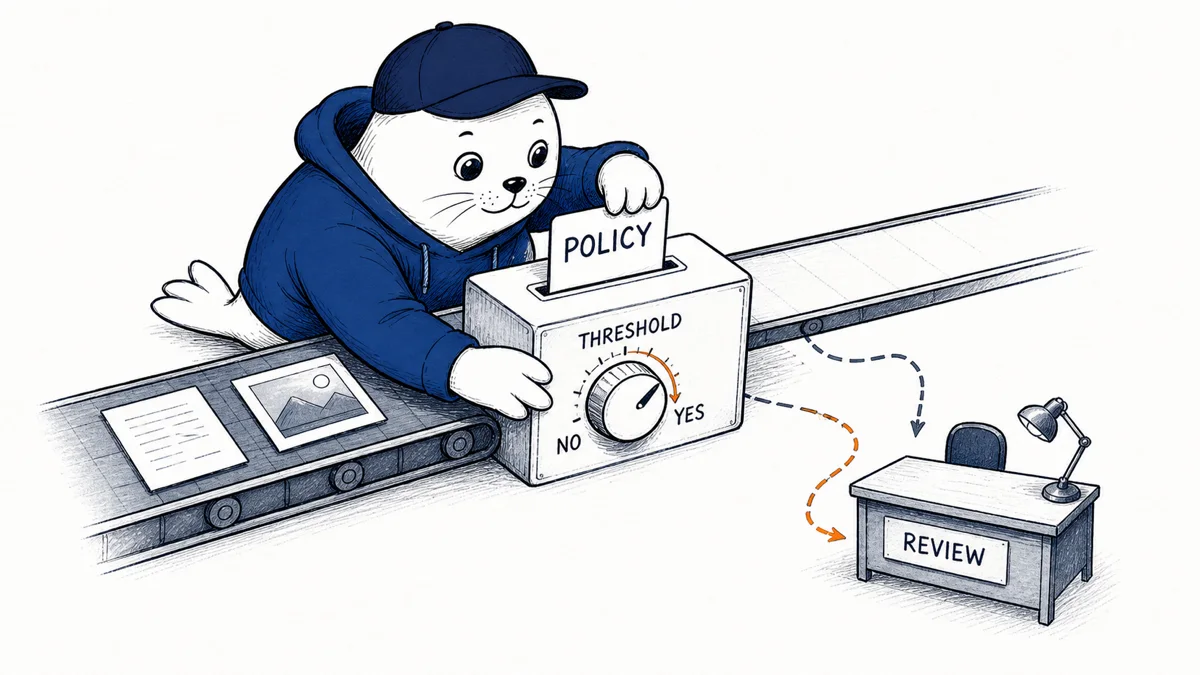
A safety classifier can accept a new policy in plain language. It cannot choose the risk your product should tolerate.
Mistral Shieldstral is a 3-billion-parameter, open-weight classifier for text, images, and combined text-image inputs. Its practical difference is that the moderation policy arrives with the content at inference time. Instead of retraining a fixed taxonomy whenever a rule changes, an operator can ask one natural-language yes-or-no policy question.
That makes Shieldstral unusually flexible for teams with different communities, products, or regional rules. It also moves an important decision into production configuration: what counts as a positive result, what threshold triggers an action, and which cases must reach a person.
The policy becomes an input, not a training label
Mistral frames moderation as binary question answering. The input contains an instruction, a policy question, and the content to evaluate. The model produces scores for "yes" and "no." A question might ask whether a post encourages a named harmful behavior or whether an image violates a marketplace rule.
The official model card says Shieldstral evaluates one policy per query. If a product has ten independent rules, the straightforward implementation requires ten calls or a separate routing layer. That operating detail matters more than a demo with one policy and one example.
Policy adaptability removes a retraining step. It does not remove policy design, threshold calibration, or appeals.
The model is small enough to make local testing realistic
Shieldstral combines a Ministral 3B base with a Pixtral vision encoder. Mistral released the weights under Apache 2.0 and documents paths for Transformers, vLLM, llama.cpp, and SGLang. The company says the model can run on one 16 GB NVIDIA GPU.
That is a company-reported deployment claim, not a guarantee for every runtime and batch size. Still, the open weights and familiar serving options make it possible to benchmark the classifier on private traffic without sending every moderation decision to a hosted endpoint.
The model card lists a trained context window of 32,000 tokens. It mentions a larger theoretical context, but recommends staying at or below the trained window. Long policy documents should therefore be normalized into specific questions rather than pasted in as an unbounded rulebook.
The reported accuracy is evidence, not your threshold
The Shieldstral paper describes a training mixture of about 54.1 million samples and a fine-grained evaluation set designed to test policy adaptability. The authors report average F1 scores of 84.9% on text safety, 83.8% on multimodal safety, and 91.3% on policy adaptability. They also report that the 3B model matches or outperforms open guard models nearly seven times larger on their selected text benchmarks.
Those figures come from Mistral and the model’s authors. They have not yet established performance on your traffic, your policy wording, your languages, or deliberate evasion attempts. F1 also compresses different error costs into one number. A missed threat and an unnecessary removal rarely have the same consequence.
The paper uses a 0.5 decision threshold. A production team should treat that as a baseline to test, not a universal setting. Measure precision and recall at several thresholds, then inspect the actual mistakes near each operating point.
One policy per call changes the cost model
- Low-volume, high-risk workflows: evaluate every relevant policy and send uncertain cases to review.
- Large rule sets: use a cheap first-stage router to select a small policy subset, then run Shieldstral on those questions.
- Fast-moving community rules: version each policy question and retain the exact text used for every decision.
- Multilingual products: test each language separately even though the model card lists support for 12 languages.
- Images with captions: test image-only, text-only, and combined inputs because the failure modes can differ.
Do not hide this fan-out behind a single "moderation cost" estimate. Ten policies can mean ten inference passes, more latency, and more opportunities for conflicting results. Record per-policy utilization, escalation rate, and reviewer overturns.
A policy question needs its own test set
- Write the policy as one observable yes-or-no question.
- Collect representative allowed, disallowed, ambiguous, and adversarial examples.
- Run the exact policy wording that production will use.
- Plot false positives and false negatives across candidate thresholds.
- Create an abstain band for cases close to the decision boundary.
- Route the abstain band and consequential actions to human review.
- Version the model, policy text, threshold, and appeal outcome together.
This is the same control-plane lesson behind our review of Reddit Rules Hub’s intent-based moderation: a model can interpret a rule while logs, queues, and override paths remain the operator’s job. Our guide to Claude Inference Hooks covers a related problem at the prompt boundary, where a policy service can block an inference request before it runs.
Keep enforcement separate from classification
Shieldstral should produce evidence for a decision system, not become the entire decision system. A separate enforcement layer should know the policy version, risk tier, threshold, permitted action, review requirement, and rollback procedure.
For low-consequence content, a high-confidence positive result might hide an item pending review. For account suspension, law-enforcement reporting, financial restrictions, or safety-critical access, the classifier should not act alone. The consequences determine the control, not the elegance of the model interface.
Our report on AI cyber-test incidents shows what happens when policy text and technical boundaries disagree. The infrastructure has to enforce the limit even when a model reaches a different conclusion.
My verdict: use the adaptability, own the operating point
Mistral Shieldstral is worth testing because it makes custom moderation policies deployable without another fine-tuning cycle and supports text plus images in one open-weight package. The one-policy-per-query design is clear enough to audit, and the small model size lowers the cost of serious local evaluation.
The release does not justify automatic enforcement from an uncalibrated 0.5 threshold. Start with one well-defined policy, a representative error set, and a review queue. Add more policies only after you can explain their cost, conflicts, and overturn rate.
Read the primary sources
- Read Mistral’s Shieldstral announcement.
- Review the Shieldstral paper on arXiv.
- Inspect the official Shieldstral model card and weights.
- Check Mistral’s deployment documentation.
Which policy would you trust only after seeing the false negatives near its production threshold?
Checked August 10, 2026. Architecture, data scale, benchmark results, language and context claims, runtime support, and hardware guidance come from Mistral’s paper, announcement, model card, and documentation. Performance and hardware statements are company-reported.