

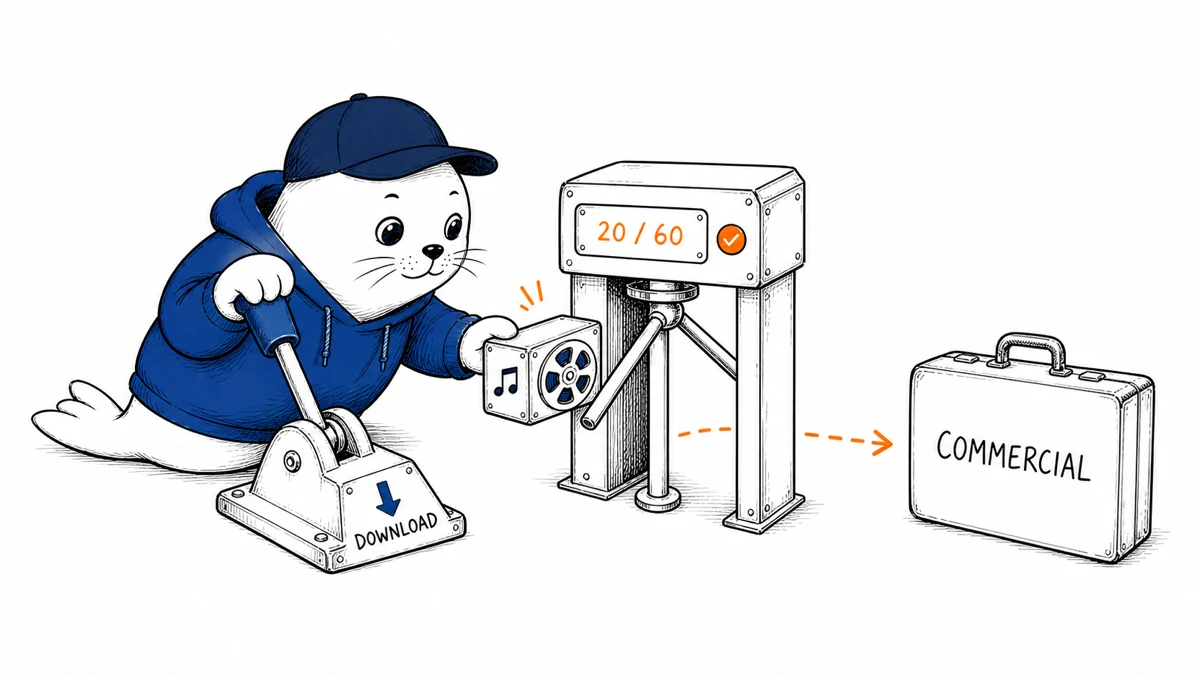
Suno is not limiting how many ideas can be generated. It is limiting how many songs can leave the platform, and its new contract makes that exit part of the commercial-rights record.
The Suno download limits take effect on September 3, 2026. Free accounts get seven trial downloads for the life of the account. Pro gets 20 songs per billing month. Premier gets 60. Premier subscribers working inside Suno Studio keep unlimited Studio downloads.
The quota is only half the update. Suno’s preview terms say commercial use requires a permitted download through an approved Suno channel. That makes the export event, not just the generation date or subscription status, something a working creator should be able to document.
The monthly numbers are easy. The definition of a download matters more
| Plan | Allowance | Reset | Commercial-use position |
|---|---|---|---|
| Free | Up to 7 songs total | No reset; lifetime trial allowance | Personal, non-commercial use only |
| Pro | 20 songs per month | Billing date; no rollover | Permitted paid-plan downloads may be used commercially |
| Premier | 60 songs per month | Billing date; no rollover | Permitted paid-plan downloads may be used commercially |
| Premier using Studio | Unlimited Studio downloads | Not subject to the song cap | Studio exports still have to follow the terms |
Suno counts unique songs, not every file click. Downloading the same song twice, or downloading it in another format, still counts once. A song and its stems also count as one download. Failed or interrupted attempts do not consume the quota.
That detail makes the cap less restrictive than "20 files" sounds. It does not solve the backlog problem. Starting September 3, the limit applies to every song in an account, including music created before the policy change.
Commercial use now passes through an approved export
The current terms, revised March 26, assign Suno’s interest in outputs generated during a Pro or Premier subscription. The September version changes the operational test. A paying subscriber may commercially exploit an output only after obtaining it as a permitted download under the applicable allocation.
The new text also says those contractual commercial-use rights survive later quota exhaustion, a price or allocation change, and the expiry, cancellation, downgrade, or suspension of the subscription. In plain English: once a qualifying song has been downloaded correctly, using the rest of the month’s quota or cancelling later does not revoke Suno’s stated grant for that download.
That is not the same as a guarantee of copyright. Suno continues to say it cannot promise that copyright will vest in an output, and it warns that similar outputs may be generated for other people. A distributor, publisher, marketplace, or collecting society can also impose its own rules.
A paid generation is not the record to keep. The approved download, plan status, song ID, and date are the useful evidence bundle.
Two traps sit beside the commercial-rights clarification
- Remixes remain non-commercial. The new terms say a Remix is for lawful personal and non-commercial use regardless of subscription tier or whether it was downloaded, unless Suno provides a separate offering.
- Workarounds are not permitted downloads. The terms prohibit obtaining copies through screen recording or stream ripping. They also allow Suno to add fingerprints, watermarks, or metadata and prohibit removing them to conceal provenance, tier, or download status.
Suno says the limits and provenance signals are intended to make mass export and fraud harder. That is a company rationale, not a measured outcome. The practical point is narrower: if a song is headed to a client, game, podcast, ad, or distributor, use the official download control and preserve the surrounding record.
The provenance language also belongs beside the wider shift toward durable AI-content signals. Our review of California’s AI transparency law explains why an invisible marker can be useful without answering every ownership question.
Your old library stays online, but online access is not an archive
Suno says existing songs will remain playable and shareable on every plan. Cancelling a paid subscription also leaves the library in the account, with future downloads following the free-tier rules.
That is useful continuity, but it is not the same as holding a local master. A creator with 300 unfinished or approved songs cannot export the whole backlog on a Pro plan in one month after the change. At 20 unique songs per billing cycle, the theoretical annual capacity is 240. Premier’s 60-per-month allowance is 720 per year. Because unused downloads do not roll over, those annual figures are planning calculations, not banked credits.
For a steadier workflow, Pro averages about 4.6 unique exports a week and Premier about 13.8. A bursty release schedule will feel tighter than those averages suggest. Suno says extra downloads will be sold, but it has not announced their price.
The old models are retiring on a separate clock
Suno also says a new generation of models is coming and that all prior models will retire when the new models launch. The company did not say the model launch will happen on September 3.
Existing songs will stay intact. They can still be used as the starting point for extensions, covers, and remixes, but those new operations will run on the replacement models and may sound different. If an old model is part of a repeatable production method, save the final audio, stems, prompt notes, version name, and any downstream edits now. "The song remains in my library" does not preserve a reproducible model workflow.
Cancelling a plan and rejecting the terms are not described the same way
The FAQ says a subscriber may cancel and keep the account library. The preview terms use stronger language for someone who does not accept the update: close the account before the renewal date or 30 days after September 3, whichever comes first. Thirty days after the effective date is October 3.
Those are different actions. Closing an account may affect access in a way that cancelling a subscription does not. If preserving a large library matters, export it and ask Suno support for a written answer before deleting the account. The updated dispute section also deserves a direct read: it defines a mass arbitration as 25 or more similar disputes and adds a staged process. This article is a practical reading of the published text, not legal advice.
What to do before September 3
- Triage the backlog. Mark the songs that support a client deliverable, release, portfolio, or repeatable production workflow.
- Export through Suno. Download the audio and stems through the approved control. Do not rely on a browser recording or stream rip.
- Save the license record. Keep the song URL or ID, download date, plan invoice, model version, prompt notes, and the terms version beside the files.
- Separate remixes. Do not mix joint remixes into a commercial catalog merely because they were created or downloaded on a paid plan.
- Measure the real export rate. If the team regularly approves more than 20 unique songs per month, Pro no longer fits without extra purchases. More than 60 points toward Premier Studio or a different pipeline.
- Decide before renewal. If the new policy changes the value of an annual or monthly plan, check the billing date and ask support about cancellation, refunds available under local law, and account closure before acting.
If you are evaluating Suno rather than managing an established catalog, start with our Suno tool profile. The new policy makes export volume and recordkeeping part of the buying decision, not an afterthought.
My verdict: treat the download as a licensing checkpoint
Suno’s cap is designed around songs leaving the platform, not ideas being generated inside it. For casual creators, one-song counting and bundled stems make the limits more workable than the headline suggests. For agencies, game teams, catalog builders, and prolific musicians, 20 or 60 monthly approvals can become the narrowest point in the pipeline.
The safest workflow is boring and useful: choose the song, export it through the official channel while paid, preserve the proof, and then move it into the rest of the production stack. After September 3, that download is not merely file delivery. Under Suno’s own terms, it is part of the commercial-use chain.
Read the primary sources
- Read Suno’s download-policy announcement.
- Compare the September 3 Terms of Service with the current terms.
- Check Suno’s download, model, and terms FAQ.
- Review the Warner Music Group partnership release for the earlier model and download commitments.
Which part of your music workflow would break first at 20 approved exports per month?