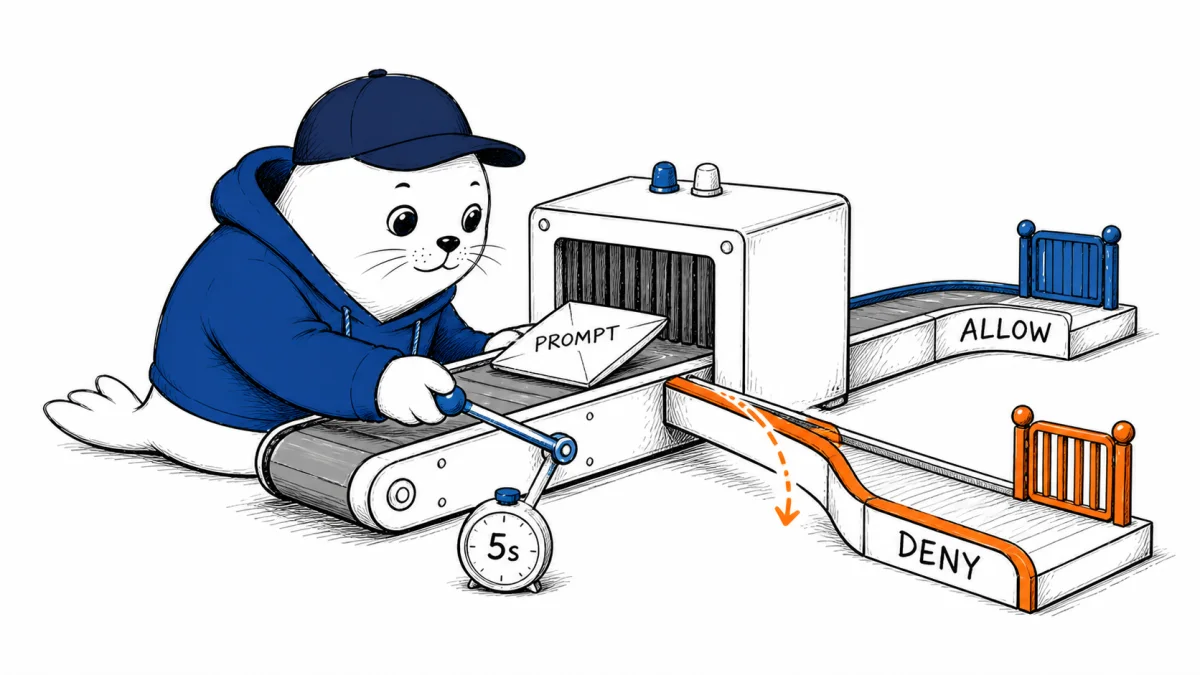
Claude Enterprise can now stop a prompt at the door, send the conversation to a company-controlled policy server, and wait for permission before the model sees it. That makes AI governance immediate. It also puts another service, timeout, and failure choice in the path of every governed turn.
Claude Inference Hooks intercept prompts before the model runs
Anthropic added Claude Inference Hooks in beta for Claude Enterprise organizations on August 5. The feature sends each governed prompt to an HTTPS endpoint run by the organization or its security vendor. Anthropic holds the request until that server returns allow, returns deny, or misses the configured deadline.
A denied request never reaches the model. That is the important difference from an audit feed reviewed after the conversation. Security teams can use the hook for data-loss prevention, prompt telemetry, transcript archiving, model rules, or other company policy before inference happens.
The request now has a policy checkpoint
Anthropic makes the call from its servers, so there is no client agent to install. The customer endpoint decides whether inference continues.
User prompt
claude.ai, Cowork, or Claude Code
→
Policy server
Signed transcript request; allow or deny
→
Claude model
Runs only after an allow verdict
There is one hook event today: prompt. Anthropic says response-side enforcement is planned for a later event. The current feature can stop sensitive input from reaching the model, but it cannot inspect the answer on the way back to the user.
Your security endpoint becomes production infrastructure
The policy server is not a background dashboard. It sits in the request path. Anthropic’s default verdict timeout is 5,000 milliseconds, configurable from 1 to 10,000 milliseconds, and that budget covers the entire exchange.
If a policy check consumes the full default timeout, the user can wait up to five extra seconds before the failure rule decides what happens. Four timed-out turns could therefore add up to 20 seconds of waiting. That is arithmetic from the configured limit, not a prediction of normal latency. A healthy deployment should answer far faster.
The endpoint must be a publicly routable HTTPS URL on port 443, with a publicly trusted certificate and no redirects. Requests are signed using the Standard Webhooks specification after the organization creates its signing secret. The sample allow-all server in Anthropic’s documentation is useful for a first round trip, but the docs explicitly warn that it accepts unsigned traffic. Signature verification belongs in place before enforcement.
This also changes the threat model. The security service receives sensitive conversation material, so its logs, operators, backups, vendors, region, retention policy, and incident response deserve the same review as the systems it is protecting. A DLP endpoint that copies every transcript into verbose application logs can create the exposure it was meant to prevent.
Choose fail open or fail closed before users depend on it
When the endpoint is unreachable, returns an invalid response, or misses the timeout, the administrator chooses between two behaviors. Anthropic labels them "Allow the request" and "Block the request." The first saved configuration defaults to allow plus a 5,000ms timeout.
Failure handling is a business decision
Neither option is universally safe. Match the default to the material, users, and cost of downtime.
Fail open
Allow the request
Claude stays available when the policy server fails, but inspected traffic can reach the model without a verdict.
- Better continuity for lower-risk work.
- Requires alerts for uninspected requests.
- Do not mistake availability for enforcement.
Fail closed
Block the request
Policy coverage is preserved during a failure, but an unhealthy endpoint can stop governed Claude use across the organization.
- Stronger default for tightly controlled material.
- Requires tested recovery and clear user messaging.
- A circuit-breaker trip can become a broad outage.
Anthropic documents a circuit breaker for sustained failures attributed to the customer endpoint. When it trips, the endpoint is no longer contacted and the chosen failure rule applies to every inspected request. Under fail closed, that can block governed use until an administrator fixes the server and turns enforcement back on.
That is why the fallback is part of the product design, not an implementation footnote. Define who can change the setting, what alert opens an incident, how users request an exception, and how the organization proves that the endpoint is healthy. Anthropic notes that the console’s health panel is best-effort, so a green-looking panel is not sufficient evidence by itself.
Shadow mode measures policy without blocking people
Shadow mode sends live governed prompts to the policy server and collects its verdicts, while every request continues to the model. Users do not see denials. This is the right place to measure false positives, endpoint latency, transcript size, and policy gaps before a rule can interrupt work.
It is still real data. "Shadow" describes the enforcement behavior, not a lower-sensitivity payload. Treat the endpoint, logging, and access controls as production from the first live prompt.
Anthropic also supports a rollout percentage from 0 to 100. Sampling happens once per conversation turn, which means one conversation can be inspected on some turns and skipped on others. If an investigation needs complete conversational coverage, percentage rollout data cannot be treated as a complete transcript archive.
Know exactly what the policy server receives
The hook includes the conversation transcript up to the inference call. Anthropic says that can contain user and assistant text, tool calls and results, and text extracted from attachments. The frame can also carry an actor identifier, email when available, source application, session identifier, and public model identifier.
It does not include raw file or image bytes, system prompts, tool definitions, or Anthropic-internal context. An image-only screenshot may therefore pass through without its visual content being inspected. The verdict can only allow or deny; the hook cannot rewrite or redact the prompt.
Those boundaries matter when someone says "all Claude prompts are covered." The accurate claim is narrower: governed prompt frames on supported Claude Enterprise surfaces can be evaluated, subject to rollout, exclusions, endpoint health, failure handling, and the content Anthropic includes in the frame.
The availability matrix has important gaps
What one Enterprise hook covers today
The hook is organization-wide across supported interactive surfaces, not a universal control for every way a company can call Claude.
Surface
Scope
Hook coverage
claude.ai
Enterprise organization
Covered
Cowork
Enterprise organization
Covered
Claude Code
Web, desktop, and CLI sessions
Covered
Voice mode
Interactive voice
Not covered
Claude Platform API
Platform organizations
Out of scope
Bedrock / Google Cloud
Provider deployments
Not available
Role exclusions add another boundary. Only custom roles can be excluded, and machine-credential traffic is always inspected on supported surfaces. If Claude cannot resolve a user’s role membership, Anthropic says the request fails closed with a retryable error rather than slipping past inspection.
For API applications, provider deployments, voice, output monitoring, or image-only material, teams still need other controls. Our recent review of exposed AI coding conversations is a useful reminder that data handling around the model matters as much as the model call itself.
A practical rollout starts with observability
Here is the rollout I would use. It is my recommendation based on Anthropic’s controls, not an Anthropic requirement.
- Build an allow-only signed round trip. Verify webhook signatures, reject replays, cap body size, set timeouts, and keep content out of routine logs.
- Run shadow mode at low percentage. Start with a small slice, compare the hook’s request IDs with your own records, and measure p50, p95, and timeout rates.
- Tune with real false positives. Review the categories that would have blocked work. Give every deny rule an owner and a plain-language user message.
- Test both failure choices. Simulate DNS failure, TLS failure, slow responses, invalid JSON, and a circuit-breaker trip. Observe the user experience and audit record.
- Increase coverage in steps. Move from 5% to 25%, then 100% only after latency and policy quality stay inside agreed limits. Recheck whether sampled conversations meet your audit needs.
- Practice secret rotation. Anthropic’s rotation is an immediate cutover with no overlap period, although requests signed with the previous secret can arrive briefly. Your verifier needs a deliberate switchover plan.
Denials, configuration changes, and requests that proceeded without inspection under the failure setting are recorded in the Activity Feed. Anthropic says Activity Feed events are queryable within one minute and retained for six years. Join those records to the policy server by request identifier and keep a test that proves the join still works.
This reliability work sits beside model reliability. Our analysis of six Claude incidents shows why a control in the critical path needs its own outage plan. And if you maintain model fallbacks, the new Claude Opus 4.1 retirement checklist covers the separate risk of dead model routes.
My verdict: the hook is useful when its failure is designed
Claude Inference Hooks give Enterprise customers a real pre-inference control across claude.ai, Cowork, and Claude Code. That is more useful than another dashboard when the policy must stop sensitive material before a model sees it.
The hard part is operational. Your endpoint receives sensitive transcripts, adds latency, and can become either an enforcement gap or an organization-wide blocker when it fails. Shadow mode, signed requests, small-percentage rollout, external health checks, and a rehearsed failure policy are the minimum sensible foundation.
I would not switch this on at 100% because the checkbox exists. I would earn enforcement with real traffic, measured latency, named policy owners, and a failure drill. A pre-inference gate is valuable only when everyone knows what happens when the gatekeeper goes dark.
Go deeper
- Read Anthropic’s Inference Hooks overview and availability notes.
- Review the configuration, failure handling, rollout, and circuit-breaker guide.
- Use the integration protocol and signature-verification reference.
- Check the Activity Feed retention and query documentation.
Would your organization fail open or fail closed, and who gets to change that answer during an incident?
Checked August 5, 2026. Inference Hooks are a beta Claude Enterprise feature. Field names, request shapes, headers, availability, and limits can change before general availability.