
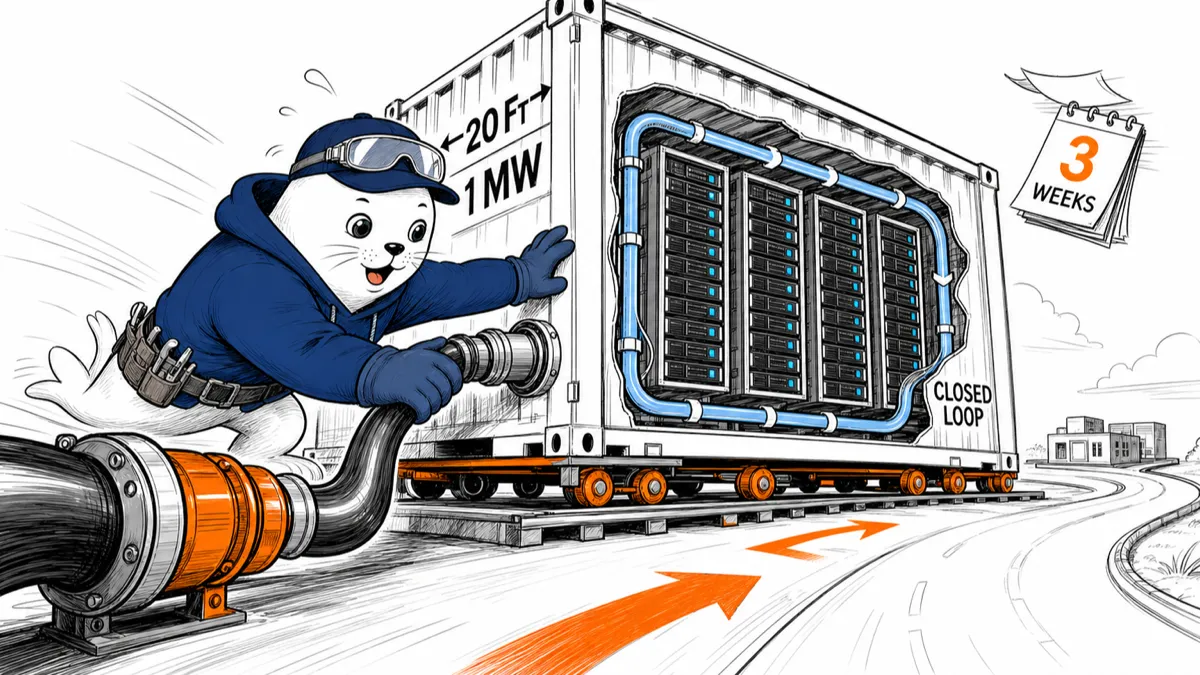
The Runware Sonic Inference Pod compresses a one-megawatt AI data center into a 20-foot container, according to the company. That could make inference capacity faster to deploy and easier to place near users. It does not make one megawatt small.
Runware says its Sonic Inference Pod combines custom hardware, liquid cooling, networking, and software in a deployable container. The company claims each pod can provide 1 MW of inference compute and move from order to operation in about three weeks rather than the years associated with a conventional data-center build.
TechCrunch reports 10 pods are in deployment across the United States, Europe, and Asia-Pacific, with 160 possible sites. Customers named by the company include Wix and Higgsfield. These are early deployment claims, not independent performance tests.
The Sonic Pod pitch in four numbers
Runware’s published specifications and company claims.
- 20 ft: Container footprint.
- 1 MW: Inference compute per pod.
- ≈3 weeks: Claimed order-to-live time.
- 400K+: Models in Runware’s shared Model Lake.
What the Runware Sonic Inference Pod changes
A traditional data center is a long, site-specific construction project. A productized pod shifts more work into a repeatable unit that can be built, shipped, connected, and replaced. Capacity can arrive in smaller increments instead of waiting for an entire campus.
That is especially attractive for inference. Training runs can justify giant centralized clusters. Inference serves real user requests, where latency, regional availability, and changing model demand matter. A distributed pod can sit closer to a market or power source and add capacity when traffic grows.
Runware’s software layer is central to the pitch. It routes each request across a fleet and streams model weights from a shared library. The company claims sub-second cold starts, but buyers need workload-specific tests; an image model, video model, and large language model stress memory and networking differently.
One megawatt is 24 megawatt-hours per full day
Power scenarios, not consumption claims
Simple capacity math if pods operated at their full 1 MW rating for 24 hours.
- One pod: 24 MWh/day 1 MW × 24 hours. Actual use depends on utilization, cooling, and site design.
- Ten same-spec pods: 240 MWh/day A 10 MW / 240 MWh scenario, not confirmation that every deployed pod has this rating or runs continuously.
This calculation is the right antidote to “portable means light.” The pod may avoid a multi-year campus, reduce transmission distance, and use a closed cooling loop. It still needs a serious and reliable electricity source.
Runware told TechCrunch that its cooling design does not use water in operation and that it can deploy where existing power is available. Buyers and communities should verify the full system boundary: initial fill, maintenance, electricity source, backup generation, noise, heat rejection, and what happens during grid stress.
That is why the new Texas data center audit asks projects to document power, water, cooling, incentives, ownership, and community impact before grid access.
The company’s economics need workload-level proof
Runware claims 90% lower capital cost than a traditional data center and roughly ten-times-lower inference pricing on parts of its platform. Those figures are company marketing claims and depend on the comparison baseline.
A useful buyer model separates hardware utilization, energy, network transit, operations, model loading, failure recovery, and reserved capacity. A pod with excellent theoretical density can be expensive if workloads arrive unevenly or if specialized hardware sits idle.
The portable-inference due-diligence card
Numbers to request before accepting the headline economics.
- Price per successful output: Include retries, moderation, storage, and egress rather than compute time alone.
- Sustained throughput: Test your model, resolution, context, batch size, and concurrency.
- Energy per output: Report at realistic utilization and include cooling overhead.
- Availability: Failure domains, spare capacity, maintenance, and regional failover.
- Deployment reality: Permits, transformer, interconnection, fiber, noise, and site preparation.
- Upgrade path: How hardware refreshes happen without stranding the whole container.
Runware has real scale signals: it announced a $50 million Series A in January and says it has powered more than 10 billion generations for over 200,000 developers and 300 million end users. Those are company-reported totals, but they give the pod strategy an operating base beyond a rendering.
Builders comparing providers should use the same discipline as our AI model evaluation guide: test the full task, not the most flattering benchmark.
Portable compute moves the permitting question
A modular pod can reduce construction risk. It can also encourage projects to describe infrastructure as temporary or small even when several units form a major load. Ten containers are still a site. A fleet across 160 locations is still an infrastructure network.
Local rules need thresholds based on aggregate power, noise, emissions, and water, not the dimensions of each container. Operators should publish site-level totals and cumulative expansions so communities can see when modular capacity becomes a campus by increments.
The upside is reversibility. If a pod truly can move, a region is less likely to be left with a specialized empty shell when demand changes. The operator still needs a decommissioning plan for equipment, coolant, batteries, cabling, and site restoration.
My read: fast deployment is valuable; transparent utilization is decisive
The Runware Sonic Inference Pod addresses a real bottleneck. Model demand changes faster than conventional data centers can be planned and built. Productized infrastructure can shorten that gap.
Its strongest proof will not be “1 MW in 20 feet.” It will be audited energy per useful output, sustained customer workloads, uptime across multiple sites, and evidence that claimed capital savings survive grid connection and operations.
If those numbers hold, pods can become a meaningful inference layer. If they do not, portability simply makes a large load easier to move from one spreadsheet to another.
Go deeper
- Review Runware’s Sonic Inference specifications.
- Read the company’s $50 million Series A announcement.
- See our analysis of how AI compute reaches local power infrastructure.
Reporting checked August 4, 2026. Pod specifications, performance, market, and customer figures are attributed to Runware. Energy figures are clearly labeled capacity scenarios, not measured consumption.