
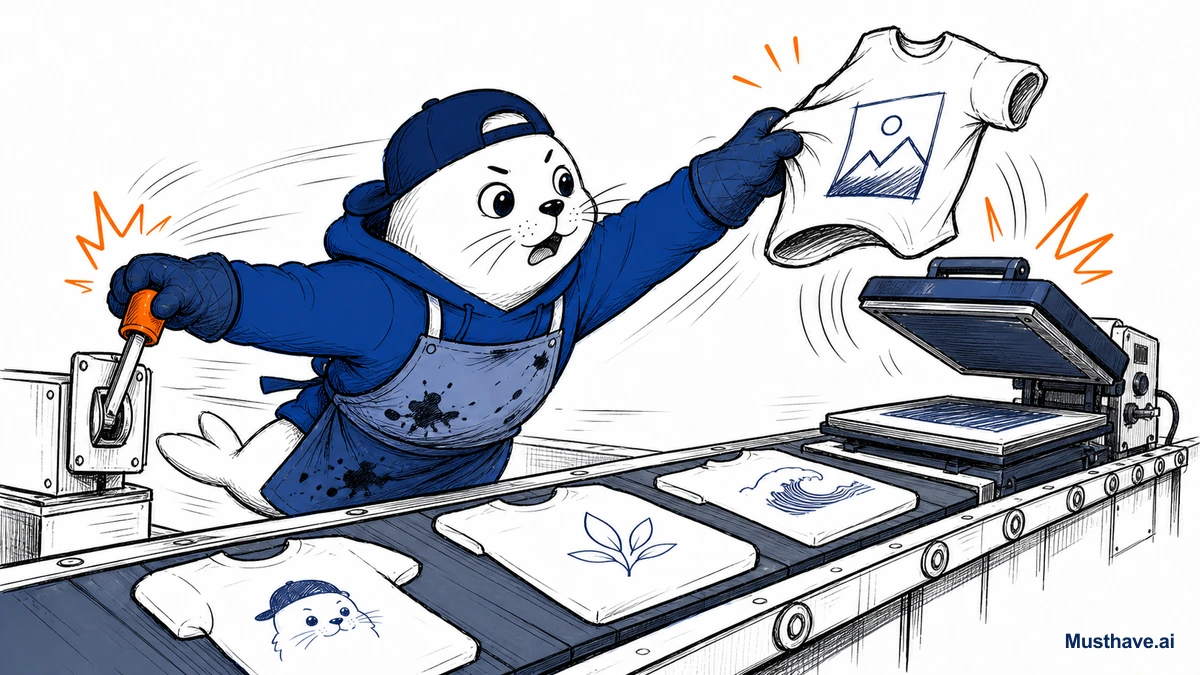
Almost every horror story about a suspended Merch account comes down to the same handful of avoidable mistakes. AI makes it faster than ever to produce designs, and faster than ever to produce the kind that get you banned. So let’s skip the inspiration and talk rules: the boring guardrails that keep you selling.
Rule 1: Trademarks are the account-killer
If you remember one thing, make it this. The fastest way to lose a Merch account isn’t low sales, it’s trademark infringement. Do not put brands, logos, cartoon characters, sports teams, song lyrics, movie quotes, or celebrity names on your designs. Not as “parody,” not because you’ve seen a hundred others do it and get away with it.
Amazon’s enforcement is strict and often automated, and a violation can suspend your entire account, not just remove the one design. AI makes this trap easier to fall into, too, ask a generator for a “superhero-style” design and it may hand you something legally radioactive. You are responsible for what you upload, regardless of what the AI produced.
Rule 2: Do a 30-second trademark search
Here’s the cheap habit that prevents most disasters. Before you upload a text design, search the exact phrase in a trademark database (the USPTO’s TESS is free). Plenty of ordinary-sounding slogans (the kind AI loves to generate) are registered trademarks in the apparel class. Thirty seconds of checking beats losing months of work. If a phrase is registered for shirts, pick a different one.
Rule 3: Disclose AI content honestly
Amazon now asks about AI-generated content when you publish, and honesty is the safe policy. There’s a real distinction between “AI-assisted” (you meaningfully directed and edited it) and “AI-generated” (the tool made it), and platforms treat them differently. Don’t try to game the question. Getting flagged for a false declaration is a far bigger problem than an honest disclosure ever will be.
Rule 4: Quality is a rule, not a suggestion
This is where the “flood the store with AI” crowd gets wiped out. Amazon actively removes content it judges to be low-quality, spammy, or duplicative, and doing it at scale flags your account as exactly the kind of behavior they’re trying to stamp out. A pile of near-identical AI designs isn’t a strategy; it’s a liability.
The safe move is the same as the smart move: fewer, better, genuinely distinct designs made for real niches. Quality keeps you compliant and makes you money. Junk does neither.
Rule 5: Respect the technical specs
Boring but real: bad files get rejected. For Merch, that means a transparent PNG at the correct resolution and DPI (aim high, roughly 4500 x 5400 px at 300 DPI), under the file-size limit, in the right color space. And design with the garment in mind, a design that pops on white can disappear on a dark shirt. Always zoom to thumbnail size and confirm the text is readable, because that’s how customers first see it.
The mindset that keeps you safe
Put it together and the through-line is simple: treat Merch like a real business with real rules, not a loophole to exploit. AI is a fantastic design assistant when you point it at original, trademark-clean, niche-specific work. It’s an account-suspension machine when you use it to mass-produce derivative junk.
Follow these five rules and you remove almost every common reason accounts get banned. Then you get to focus on the fun part, finding niches and making designs people actually want to wear.
The 30-second pre-upload checklist
Turn the rules into a habit by running this exact checklist before every Merch upload. One: is every word in the design free of brands, characters, teams, and celebrity names? Two: did you search the exact phrase in the free USPTO database (TESS)? Three: is the file a transparent PNG at the right resolution, readable at thumbnail size? Four: does it look right on the shirt colour, not just white? Five: did you answer the AI-content disclosure honestly? Five checks, thirty seconds, the difference between a smooth account and a suspension email you didn’t see coming.
Which of these rules has tripped you (or someone you know) up before? Share it in the comments so others can dodge it.
Verification sources and related guides
Primary reference: Amazon Merch on Demand content policies. This is the controlling platform or government guidance. Recheck it before publishing, deploying, or selling because rules and eligibility can change.