
A license to use a generated song commercially does not guarantee that a streaming platform will distribute the recording.
Tidal plans to reject and remove recordings made wholly with generative AI from December 9, 2026. The change matters to creators using music generators, distributors handling their catalogs, and founders building services around automated music production.
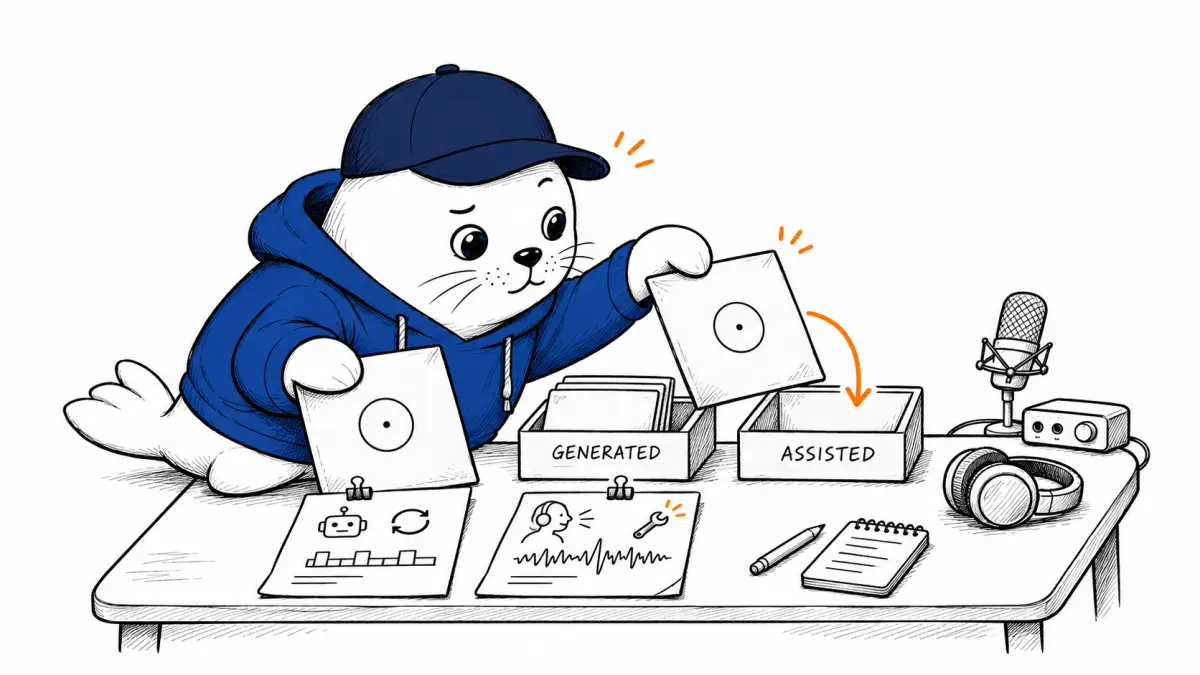
The deadline has not arrived yet. Tidal’s support policy, updated November 24, describes the upcoming change separately from its current rules. Its November 25 explanation says recordings assisted by AI tools can remain when they are not solely generated outputs.
That distinction is more useful than a general statement that Tidal is banning AI music. A creator needs to identify how a specific recording was made and what the intended distribution channel permits.
We reviewed the platform’s published policy and explanation. The catalog worksheet is our proposed review method, not a test of Tidal’s detection system or a prediction that a track will be accepted.
Put the effective date beside the recording
For an existing release, begin with the actual master and its identifiers. Record the distributor, release date, and platform destinations. A song title alone may not distinguish an original recording from a later version.
Then attach the rule that applies to the destination and date. Tidal’s December 9 change concerns recordings it determines were generated entirely with AI. A scheduled release after that date needs a different review from a historical upload awaiting clarification.
The company’s statement also distinguishes assistance from sole generation. It doesn’t provide a simple percentage threshold that guarantees acceptance. Adding a small human change should not be treated as a reliable way to classify a recording.
A founder building a distribution interface can make this decision easier by keeping production information beside each master. One broad account-level declaration is less useful when the catalog contains several different production methods.
Separate four questions that often get merged
The first question is how the audio was produced. The second concerns the permissions that apply to the source material and tools. The third is whether a particular platform accepts it. The fourth is whether that platform allows it to earn royalties.
An answer to one question does not settle the others. A generator’s commercial-use permission cannot promise access to every distributor. A successful platform upload does not, by itself, establish that the recording qualifies for payment.
| Question | Record to inspect | Decision it supports |
|---|---|---|
| How was this master made? | Project files and a production note | Describe the actual workflow |
| What permissions apply? | Applicable source and tool terms | Check the intended use against those terms |
| Will the destination accept it? | Current destination policy | Choose a distribution route |
| Can it earn there? | Platform payment eligibility | Avoid assuming acceptance equals royalties |
Our Suno pricing and commercial-use guide addresses a tool-level decision. Tidal’s new rule is a separate destination-level decision. Readers should check the relevant terms for the exact recording and subscription period.
For a small studio, this separation can prevent a costly mistake: budgeting a release around a distribution route that the tool’s license never guaranteed.
A 100-recording worksheet shows where review should start
Consider a fictional catalog of 100 masters. Its owner records 30 as generated-only, 25 as AI-assisted, 35 as human-recorded, and ten with insufficient production information.
These categories are invented for the example. They are not Tidal’s measured catalog composition, and they do not establish how its system would classify any audio.
| Fictional category | Masters | Next review step |
|---|---|---|
| Generated-only | 30 | Check the December 9 destination restriction |
| AI-assisted | 25 | Document the actual human and tool contributions |
| Human-recorded | 35 | Retain ordinary production and rights records |
| Unknown production history | 10 | Resolve the missing evidence before making a declaration |
The immediate review queue contains 40 masters: the 30 generated-only recordings and ten unresolved cases. That is 40% of this fictional catalog. It is a prioritization calculation, not a recommendation to delete 40 tracks.
The assisted category still needs an accurate description. A label entered by the catalog owner does not bind the platform. Keep the evidence needed to explain the workflow if the destination asks a question.
The unknown category deserves particular care. Missing documentation is not proof of AI generation. It is a reason to investigate before making a confident submission statement.
Use the platform’s figures with their denominators intact
Tidal says approximately 27 million catalog tracks were tagged as entirely AI-generated, and 96% of those had no streams in the preceding three months. Those are company-reported classification and listening figures.
Applied to the approximate tagged count, the remaining 4% is about 1.08 million tracks. This is arithmetic from Tidal’s rounded figures. It does not establish how many artists earned income or how accurately every recording was identified.
A track receiving a stream and an artist receiving a meaningful payment are different outcomes. The figures also cover a defined period, not the entire lifetime of each release.
This is why a creator’s own catalog review should use its actual release and payment records. A platform-wide percentage cannot tell one studio which of its masters has a material audience.
Prepare a useful review request if a recording is flagged
The support page provides an appeal route for people who believe a non-AI recording was incorrectly identified. Its form includes an AI flag review and a wrongly tagged option. That is a documented route, not a guarantee of reversal.
A useful evidence packet could identify the exact master, its release identifier, and the production workflow. Keep the account of human performance specific. A vague statement that the creator owns the song may not answer how the recording was produced.
Where appropriate, retain dated project files and a short explanation of the tools used. Submit only the materials requested through the relevant support or distributor channel. Do not assume that publishing private source files is necessary.
The checked policy does not establish a universal appeal deadline or turnaround time. Record the response you actually receive and any case-specific instructions. Keep the original notice so later correspondence refers to the same decision.
Give a release plan a fallback before the deadline
A practical release record can fit on one page: master identifier, production description, intended destinations, current eligibility, and unresolved questions. Assign someone to resolve each unresolved item before scheduling.
Keep marketing claims attached to the confirmed distribution plan. A founder should avoid promising that a generated soundtrack will be available everywhere when only one destination has been checked.
If a destination declines a recording, review another channel’s own rules before choosing a fallback. Tidal’s announcement does not establish the policies of other streaming services.
For tools that automate music production, the product opportunity is better production records and clearer eligibility guidance. A reliable service should preserve what happened during creation and help users make an accurate, destination-specific decision.
The immediate task is to identify which masters need review before December 9. That gives creators a concrete action without mistaking a platform policy for a universal verdict on every use of AI in music.

Abdessalam Alaoui
I'm Abdessalam Alaoui, founder of Musthave.AI. I write practical guides to AI models, tools, generative media.