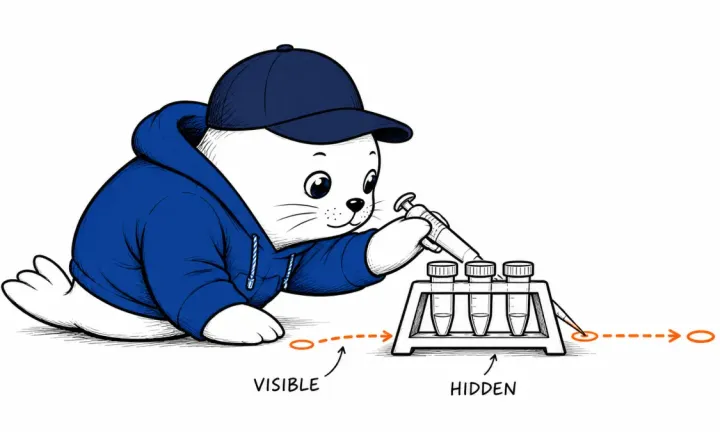

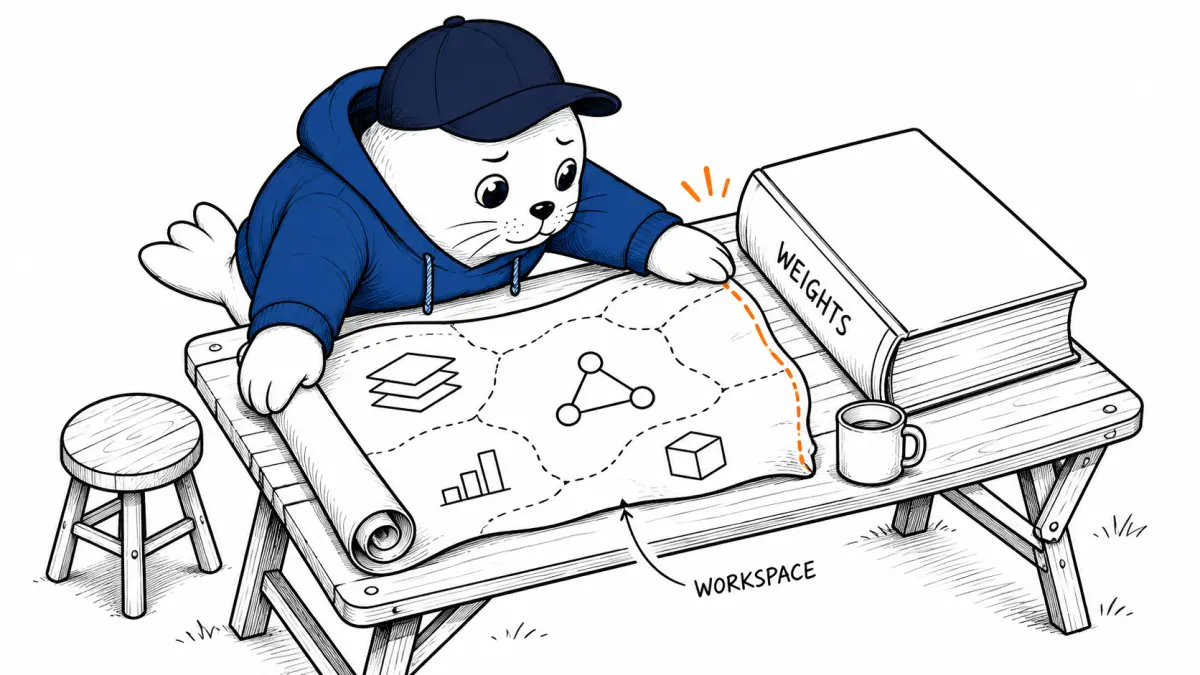
Fitting a model on your machine is the start of a local workflow. The rest of the workload still needs room to run.
Thinking Machines Lab’s Inkling 2 Mini is attracting attention among people exploring locally runnable multimodal models. The model card dates the release to November 20. A subsequent repository update is not a new launch date.
The official card lists 26.4 billion total parameters and 5.4 billion active in its evaluation table. It describes a roughly 20GB checkpoint and support for Apple silicon machines with at least 32GB of memory.
That makes the release relevant to founders who already have suitable hardware. It does not establish that every workload will fit comfortably or run fast enough for customers. We reviewed the documentation without installing or benchmarking the model.
This guide focuses on a practical decision: how to evaluate a local model without confusing checkpoint size, working memory, and a finished task. The worksheets and examples are proposed methods rather than measured Inkling results.
Keep the download, runtime, and workload in separate columns
The checkpoint stores model values. The runtime needs memory to load and execute them. A request can add more state, and other applications continue using the same machine.
Subtracting a 20GB checkpoint from a nominal 32GB machine leaves 12GB arithmetically. That doesn’t measure usable headroom. The operating system, runtime allocations, context state, and other applications can all change the result.
| Memory category | What to record | Why it matters |
|---|---|---|
| Checkpoint | Exact artifact and file size | Different distributions can package weights differently |
| Runtime | Application and version | Loading and execution need additional state |
| Request workspace | Input length, images, output limit, concurrency | A larger task can change memory use |
| Other machine use | Applications open during the test | The model shares resources with the working environment |
Do the first trial under conditions that resemble normal use. Closing every application may help diagnose a problem, but it does not represent a founder’s everyday desktop if they need a browser and editor open.
A useful record includes whether the task finishes, peak memory reported by the chosen tool, and signs of resource pressure. Keep the tool’s definition of memory attached to the number. Different measurements may describe different parts of the system.
Shared layers do not mean extra stored copies
The card describes 24 layers, with the middle 12 applied three times using shared weights. That produces 48 layer applications per token. It does not mean the checkpoint stores 48 independent layers.
The arithmetic is straightforward: the outer 12 layers run once, and the middle 12 run three times. Twelve plus 36 equals 48 applications. This distinction separates repeated computation from the amount of stored layer weights.
It also explains why parameter count alone cannot establish latency. Two architectures with similar stored sizes can perform different amounts of work per token. Hardware, runtime implementation, and the request all matter.
For a product trial, measure the wait a user experiences. Record time to the first useful response and time to completion separately. A quick first token can coexist with a long total generation.
Do not infer a speed ranking from the layer arithmetic. It describes the architecture at a high level, not the performance of a particular machine or application. A measured comparison needs the same task and acceptance rule.
Select the artifact before copying a command
The Ollama model page offers several tags with listed sizes around 18GB to 20GB. Its model descriptions also identify a 32GB-or-more Mac as the intended local hardware class.
A tag is part of the experiment. Save the exact tag and runtime version instead of recording only the family name. A later default can differ from the artifact used in an earlier result.
Choose a supported path for the hardware you already have. If the model cannot run with the tools needed for the task, that is a useful finding before buying a machine or designing a customer feature around it.
Keep local inference separate from external actions. A locally running model may still be placed inside an application that uses network services or tools. Review the application’s connections before describing the whole workflow as offline.
The model’s documentation also links its acceptable-use policy. Retain the applicable model and software terms with the artifact record. Downloadable weights do not eliminate the need to understand the components around them.
Use a fixed document task before trying an autonomous workflow
For a fictional startup, begin with a short public product brief and a screenshot containing a small pricing table. Ask the model to extract the plan names, identify the stated limits, and mark missing information explicitly.
Create the answer key first. Include one value visible only in the screenshot and one question the materials cannot answer. The test should reward evidence-based uncertainty rather than confident completion of every field.
| Test item | Expected result | Observation to save |
|---|---|---|
| Plan name in text | Exact name from the brief | Correct, wrong, or missing |
| Limit in the screenshot | Value with the correct unit | Whether the image was read accurately |
| Unstated renewal price | Explicitly unknown | Whether a price was invented |
| Conflicting source versions | Identify the conflict | Which version informed the answer |
This is an original proposed fixture. We have not run it on Inkling. It gives a founder a small, inspectable starting point before allowing an agent to modify files or interact with accounts.
Repeat the same task with a longer document only after the short version works. That isolates the effect of additional context. Changing the prompt, artifact, and document together makes a failure harder to diagnose.
Measure completed work instead of attractive output
Suppose a hypothetical batch contains 20 documents. The system produces fluent summaries for all 20, but reviewers accept only 15 without correction. The initial complete-document acceptance rate is 75%.
If five corrections take four minutes each, the batch adds 20 minutes of review. A comparison that counts only generation time omits that work. Record the correction burden even if no per-request API bill exists.
Local inference also has operating costs, including energy and maintenance. For a small first trial, measure the work before estimating a business case. Hardware utilization and reviewer effort can matter more than a headline claim about free tokens.
Keep a cloud comparison equally honest. Use the same documents, required fields, and acceptance criteria. Include failed attempts on both sides. Otherwise, the apparent winner may have received the easier definition of success.
A local model can still be useful when it is slower. A background task with a flexible deadline has different needs from an interactive support screen. Decide the deadline before comparing response times.
Make expansion depend on a clear result
Set a small release rule before the trial: required fields must be correct, unknown facts must remain unknown, and the task must finish within the chosen deadline. These are product decisions that benchmark averages cannot make for you.
Then expand one dimension at a time. Add longer context, another image, or a second simultaneous request. Save when the system stops meeting the rule, rather than reporting only the most flattering run.
Our API cost guide uses accepted work and reviewer time for a similar comparison. The billing model differs, while the need for a consistent denominator remains.
Inkling 2 Mini offers a concrete local artifact to investigate. The useful outcome is a repeatable task that works on your actual machine, with enough room and time for the rest of the product.

Abdessalam Alaoui
I'm Abdessalam Alaoui, founder of Musthave.AI. I write practical guides to AI models, tools, generative media.