
Following an object through a robot’s grip is a different test from recognizing it in a clear frame.
Ai2 has released RoboTrack, a collection of evaluation data, synthetic training data, and tracking models for robotic manipulation. The November 23 announcement focuses on a difficult moment: keeping the same point identified when a gripper or another object hides it.
For a robotics startup, two parts of the release deserve separate attention. The benchmark can reveal a tracker’s weaknesses. The downloadable components also have different licenses, so a promising score doesn’t determine which artifact fits a commercial project.
We reviewed the paper, repository, and dataset documentation. We did not reproduce the accuracy results or run a robot. The reported performance belongs to the authors; the sampling arithmetic and evaluation plan below are our analysis.
A tracking benchmark asks about continuity
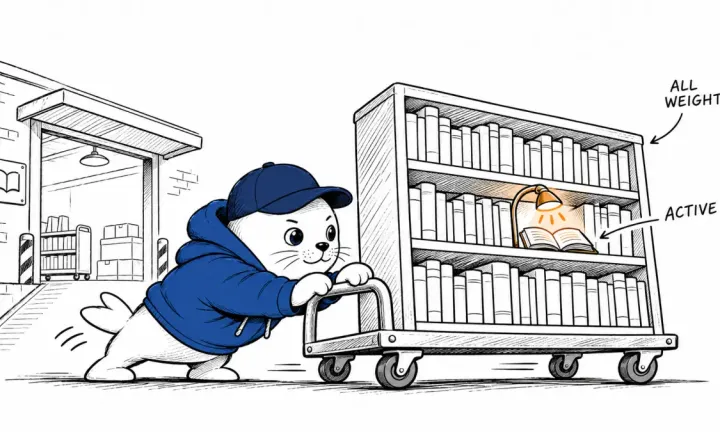
The RoboTrack-Bench card describes 307 real manipulation clips with 2,522 annotated point tracks. Its sources include robot and human footage with different viewpoints.
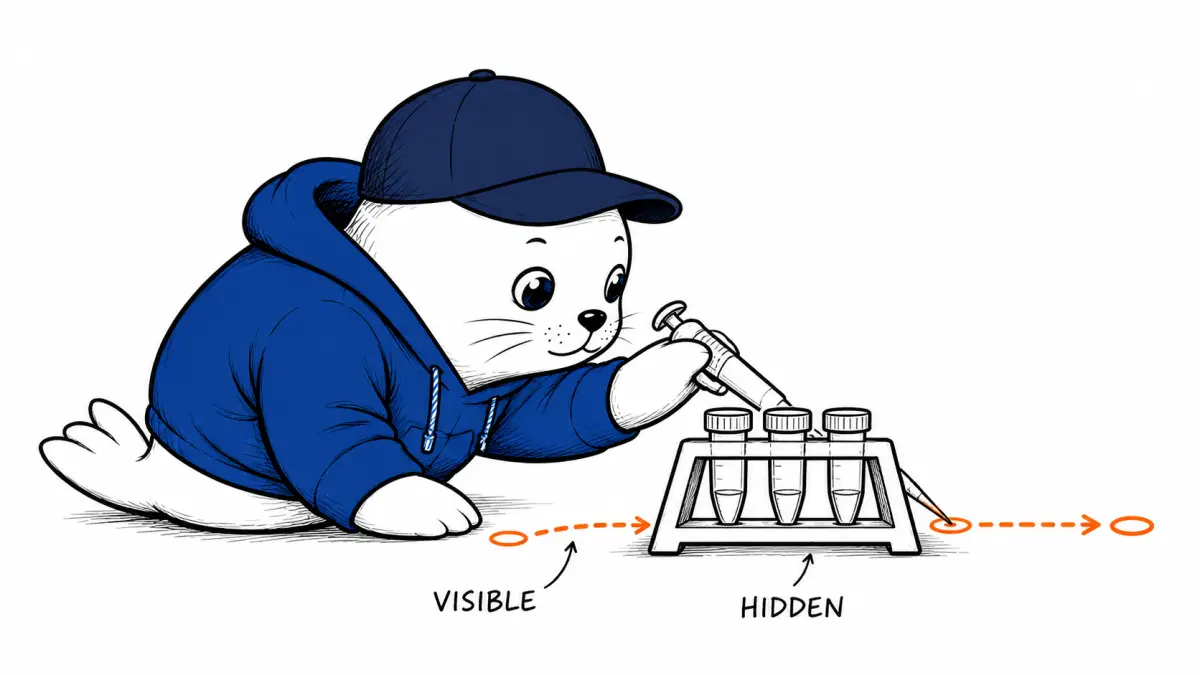
Point tracking asks where the same queried point moves over time. That differs from detecting a familiar object in each frame. A tracker must preserve correspondence when several locations look similar, or the target disappears briefly.
Imagine a robot moving a small tool behind a rack. Before the rack, the camera sees the tip. Behind it, the system must handle uncertainty. When the tip returns, attaching the track to a different bright object can produce a plausible-looking but incorrect path.
A startup evaluating a tracker should therefore include reappearance in its acceptance rule. Scoring only visible frames can omit the transition that causes the downstream controller trouble.
It should also separate visibility prediction from position accuracy. A system that admits a point is hidden behaves differently from one that confidently places it on a nearby surface. Those outputs may call for different actions.
Read the benchmark’s composition before generalizing
The paper’s source breakdown includes 167 DROID clips among 240 robot clips. That is about 69.6% of the robot subset, or 54.4% of all 307 clips. These calculations are based on the published counts.
The percentages do not invalidate the benchmark. They identify a composition detail a reader should retain when comparing it with their own robot, camera, and task. Diversity across sources does not mean every setup is equally represented.
A team can build a simple coverage matrix before running anything. List its camera position, manipulated objects, lighting changes, and common occlusions. Mark which conditions the public benchmark appears to cover and which require local examples.
| Deployment condition | Question for the evaluation | Useful local addition |
|---|---|---|
| Wrist-mounted camera | Does motion change the apparent background? | A clip with the intended camera mount |
| Repeated similar objects | Does the point return to the same object? | A handoff beside matching items |
| Long occlusion | How does confidence change while hidden? | A deliberately obscured target |
| Small target | Is the tracked point distinguishable? | A clip at the intended operating distance |
This is a proposed test matrix, not a claim that RoboTrack supplies every example. It helps turn a broad benchmark result into a specific engineering question.
Tracking accuracy and task completion have different denominators
The paper reports a wet-lab pipetting demonstration across 20 layouts. RoboTracker completed the full task in 17 trials: 10 without occlusion and 7 with occlusion, out of 10 in each group.
That is 85% across the reported 20 trials, with 100% and 70% in the two groups. These percentages are our arithmetic from the authors’ counts. They describe a small experiment, not a deployment reliability guarantee.
A point metric and a task success count answer different questions. A tracker can improve its average position estimate without completing every manipulation. A successful task can also contain temporary tracking errors that the controller tolerates.
Keep both levels when designing a local evaluation. Record where the track fails, whether the controller pauses, and whether the final task completes. Otherwise, a single completion percentage can conceal the mechanism that needs improvement.
Do not discard retries from the task record. A system that succeeds after manual repositioning can produce a different result than one that completes the original attempt. Both can be useful observations when labeled accurately.
The license belongs to the component you use
The official repository distinguishes its code, model weights, training data, and source footage. The faster-sounding model name is not a substitute for reading those distinctions.
| Component | Terms listed by the project | Decision to keep separate |
|---|---|---|
| Repository code | Apache 2.0, with identified third-party code | Read included dependency licenses |
| RoboTracker weights | Apache 2.0 | Identify the exact checkpoint |
| RoboTracker-Warp weights | CC-BY-NC 4.0 | Noncommercial restriction matters for product use |
| CoWTracker-related code and trainer | FAIR Noncommercial Research License | Do not assume the repository’s main license covers it |
| RoboTrack-15M and benchmark annotations | ODC-BY | Retain applicable attribution and dataset terms |
| Benchmark source videos | Original source terms remain | Review the source of each reused clip |
The repository lists DROID footage as CC-BY-4.0, while the benchmark card contains inconsistent wording in its DROID attribution. Resolve that discrepancy with the upstream source before redistributing those clips.
The practical point is narrow: do not describe the entire bundle as commercially unrestricted. Keep a component inventory for the particular code, weights, and data being considered. A permissive code license does not erase a separate model restriction.
A useful pilot starts with a bounded offline question
Before connecting a new tracker to motion, choose an offline question such as “does it recover the same tool tip after this occlusion?” Use recorded non-sensitive clips with an answer that a reviewer can inspect.
Freeze the clips and queried points before comparing systems. Save the model revision and runtime settings. If one model starts from a different point, the comparison may reflect the setup rather than the tracking method.
Record visible-frame error, hidden-state behavior, and recovery after reappearance separately. Add a short reviewer note for failures that a mean score can obscure, such as switching between two similar objects.
The repository itself warns that tracks can be wrong and recommends bounded motion, supervision, and an emergency stop when tracks guide a robot. An offline result does not remove the need to validate the complete controller.
A small team can make the review manageable by first selecting a few representative cases. Expand the collection when a new failure type appears. Keep the old cases so an improvement on the new task does not hide a regression.
Use the release to improve the question, then the system
The paper identifies remaining weaknesses, including long occlusions and small targets. Its authors also note that the benchmark is modest in scale and does not cover every manipulation skill.
Those limitations help define the next engineering task. A warehouse picker, a wet-lab tool handler, and a household robot do not share identical visual conditions. Choose evidence that resembles the intended work.
RoboTrack gives builders a more explicit way to examine continuity under manipulation. Its value is clearest when the benchmark result, component terms, and local task outcome remain visible as separate pieces of evidence.

Abdessalam Alaoui
I'm Abdessalam Alaoui, founder of Musthave.AI. I write practical guides to AI models, tools, generative media.