
The expensive surprise in an AI episode can hit between shots: the coat changes, the room shifts, or a character delivers a line nobody wrote.
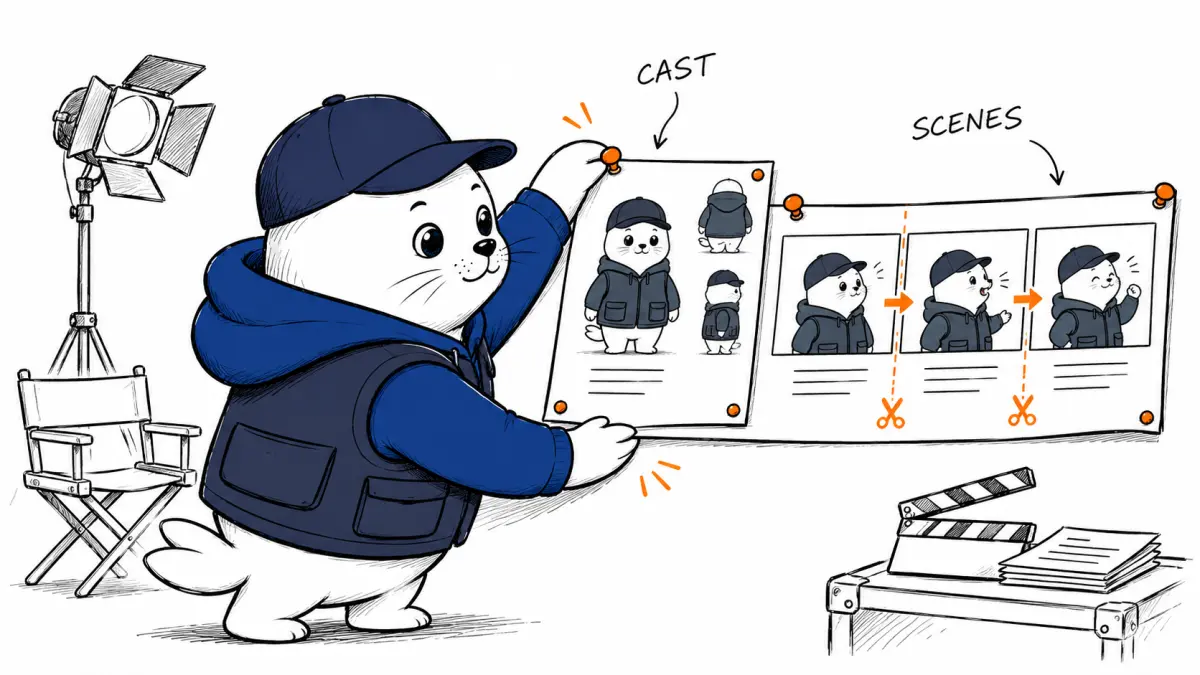
Higgsfield Short Drama presents a workflow that takes a script through cast and scene preparation to finished episodes. Its public page accepts PDF, DOCX, FDX, TXT, and Markdown files up to 10 MB. It also links to Claude and ChatGPT entry points. This is a guide to the documented workflow and production decisions, not a hands-on review of rendered episodes.
For a creator, I would start with one short scene and a spending limit. Approve the cast references and the scene plan before generating a series. The product page alone does not establish a fixed episode price, universal plan eligibility, or a guaranteed level of character consistency.
What the agent workflow asks you to approve
Higgsfield’s MCP page includes a Short Drama prompt built around /short-drama. It asks what the creator already has, such as a script or an idea, and calls for a plan and price before generation. It describes a consistent cast, locations, and visual style as the intended output.
That approval step is where a producer should slow down. A plan should identify the episode being made, the scene boundaries, and the cost of the proposed work. Ask what happens when a shot fails and whether a retry creates another charge. Keep the accepted plan with the project so later revisions can be compared with it.
A chat entry point should also identify the account and balance that pay for the work. Connecting a creative service to an assistant does not establish that an existing web allowance follows the connection. Confirm the billing route before approving a generation request.
Web allowances and MCP spending need separate checks
Higgsfield’s official pricing document, dated November 24, 2026, says unlimited allowances and free generations apply on its website, not MCP/CLI, Canvas, or Supercomputer. It also warns that access to advanced features can roll out gradually. Those conditions matter more to a Short Drama budget than a broad “unlimited” headline.
The same US pricing document lists Plus with 1,200 monthly credits: $40 for the first month, then $59 per month. The annual offer is $360 upfront, or $30 per month. The sale is listed to end on November 25 at 00:00 UTC. These are time-limited published rates, before local taxes, and do not establish a Short Drama episode cost.
Compare the actual checkout price, the route you will use, and the quote for your project. Ask whether the quote includes planning, reference assets, dialogue, revisions, and the final export. Do not infer feature entitlement from the existence of a public landing page. If access is absent from your account, resolve it before buying a plan for this particular job.
Make a continuity sheet before the first episode
A useful character reference describes what should stay stable when the camera changes. Give the character a name, a costume description, and an approved visual reference. Record details that affect the story, such as which hand holds a prop. Avoid filling the sheet with decorative traits that nobody needs to evaluate.
Then describe the room. Note the position of the door, the main light source, and objects that must remain in place. When a scene depends on someone noticing an envelope on a desk, the envelope’s location is part of the plot. It deserves a clearer instruction than a general mood description.
I would keep the dialogue beside those references. Every line needs a speaker and an intended response. A beautiful close-up is unusable if the wrong character speaks or the response changes the scene’s meaning. Review that relationship before spending on extra camera coverage.
A small scene exposes the important failure modes
Try a fictional scene with two characters in one room and a single prop handoff. Give it a clear beginning and consequence. For example, one character arrives with a sealed envelope; the other opens it and changes their plan. This is a proposed production exercise, not an episode MustHave.ai has generated.
| Shot | Story job | Continuity to review |
|---|---|---|
| Arrival | Establish who enters and what they carry. | Costume, room layout and envelope. |
| Handoff | Transfer the envelope to the second character. | Correct hands, position, and prop ownership. |
| Reaction | Show the consequence of reading the message. | Speaker, expression and the next story action. |
Review the sequence in order, with sound, before deciding which shots pass. Keep the rejected versions and a brief reason for each rejection. “Wrong hand during transfer” is actionable. “Make it more cinematic” can create expensive iterations without a clear stopping point.
Calculate the cost of an accepted scene
A hypothetical budget makes the difference visible. Suppose a scene needs eight accepted shots. Each generation attempt costs 15 credits, and the team averages three attempts per accepted shot. That’s 24 attempts and 360 credits. These assumptions are illustrative; they are not Higgsfield rates or an observed success rate.
If revision work adds two more attempts for each of three difficult shots, the total becomes 30 attempts and 450 credits. The extra 90 credits increase generation spending by 25%. A small change in acceptance can therefore affect a project more than the number of shots in its final cut suggests.
Review time belongs in the budget too. At a hypothetical two minutes per attempt, the first plan needs 48 minutes of review. The revised plan needs 60 minutes. At an assumed $30 per hour, that is $24 or $30 of reviewer time, respectively. Editing and final delivery would add further work.
Use the quote’s actual credit cost in place of 15. Keep credits and cash in separate columns until you know the applicable conversion and allowances. For a broader comparison, see MustHave.ai’s guide to budgeting accepted AI video shots. It explains why provider credits cannot be compared as though they were one currency.
Define revisions before approving the full series
Approve the script, references, and first scene as separate milestones. After each approval, name what can change next. A request to alter a costume halfway through a series can affect every shot that uses it. An edit to one reaction may leave the rest intact.
Keep a shot register with the accepted version, its inputs, and the reason it passed. Give a replacement a new version number. This helps a producer return to a workable cut if a later generation fixes one problem but introduces another.
Set a stop rule for the trial. That might be a fixed credit ceiling or a maximum number of attempts for the prop handoff. If the trial fails, change the scene design before buying more attempts. A simpler cut can be a better production decision than repeatedly asking for the same difficult movement.
Commercial use still needs rights review
Higgsfield’s terms say it does not claim ownership of inputs or outputs and does not restrict commercial use of outputs. They also place responsibility for rights clearances on the user and do not guarantee output uniqueness. That permission does not establish ownership of every reference supplied to a project.
Use scripts, voices, and likenesses you are authorized to use. Keep the relevant permissions with the project. If a client supplies a recognizable person’s image, confirm the intended use before generating dialogue or an endorsement. For contractual or legal questions, get advice suited to the actual production and market.
Also agree on what the client receives: the final cut, subtitle files, approved references, or editable project assets. Confirm the export formats the account actually supports. A preview in a workspace is not the same deliverable as a finished file a client can publish.
Judge the workflow by the first coherent scene
Short Drama’s documented appeal is a connected production path from a story to episodes. Evaluate that path with a small scene whose dialogue and continuity you can inspect. Approve further spending only after the result meets the story’s acceptance rules.
Before starting, confirm access in your account and request the route-specific price. What’s your first test: a dialogue exchange, a prop handoff, or a recurring character across two locations?

Abdessalam Alaoui
I'm Abdessalam Alaoui, founder of Musthave.AI. I write practical guides to AI models, tools, generative media.