

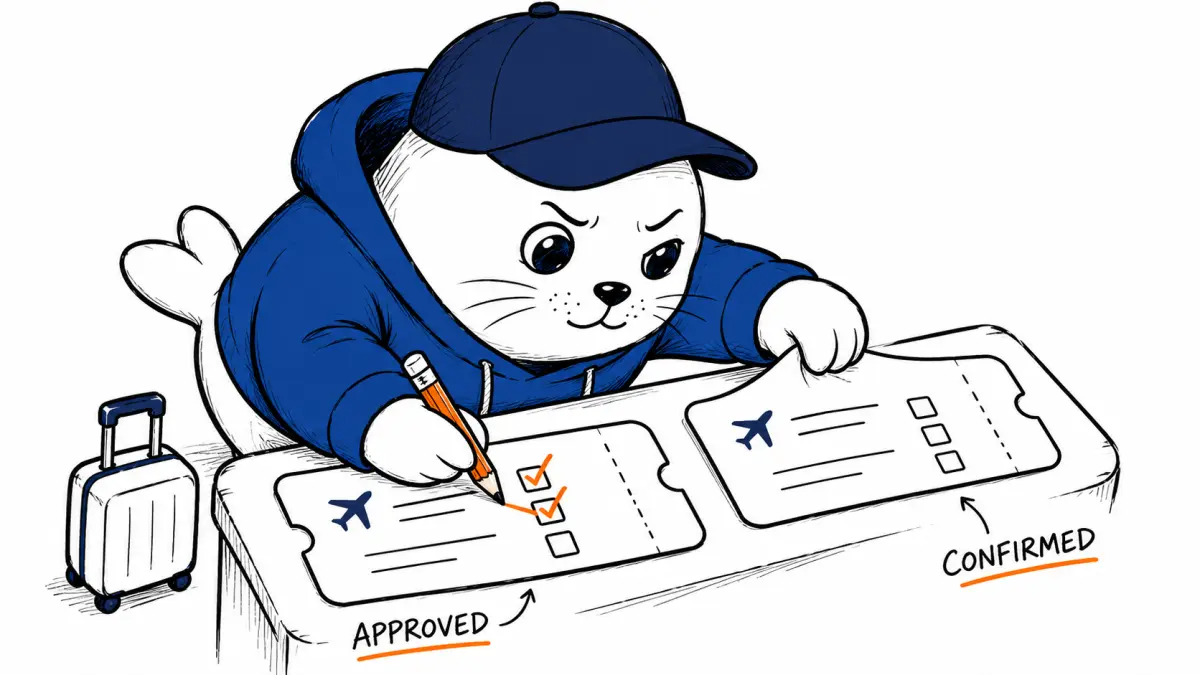
The useful end of an AI travel search is a confirmed trip you meant to buy, with the fare rules you agreed to.
Grok Bot’s November 16 and November 18 updates make its travel workflow more explicit. Flight results expose booking details, and the assistant returns a link when it can’t confirm a purchase is finished. Those changes deserve attention from founders who delegate business travel, especially when a cheap fare has restrictions that change the trip’s cost.
The practical approach is to separate searching, authorizing a purchase, and checking the merchant’s confirmation. A chat reply can help with each stage, but the traveler still needs a record of what was bought. This is a documentation-based explanation and a proposed evaluation workflow. We have not bought a flight, hotel, or rental car through Grok Bot.
What changed in the travel workflow
The official changelog dates the redesigned flight results to November 16, 2026. Travelers can inspect fare conditions before proceeding. The assistant also identifies filters it relaxed when it could not find an exact match. Its November 18 entry says an uncertain final purchase should end with a link for the user, rather than another purchase attempt.
That creates a useful distinction for a busy founder. A suggested itinerary might meet the budget while missing a required arrival time. A reservation attempt might reach checkout without producing a ticket. Each state calls for a different next action.
Hotel photos and maps can help someone judge a location. They cannot establish whether a room rate includes the cancellation terms that person needs. Keep the booking conditions alongside the visual comparison, particularly for a meeting that could move.
Write the trip brief before asking for options
A search becomes easier to judge when the constraints are specific. Name the destination airport, travel dates, latest acceptable arrival, and required baggage. Add whether a connection is acceptable. For a hotel, specify the nights, number of guests, and the actual place you need to reach.
Distinguish preferences from requirements. An aisle seat may be a preference. Arrival before a client meeting may be essential. If you mix those into one paragraph, a cheaper alternative can look attractive while quietly failing the purpose of the trip.
A proposed starting request is: “Find two return-flight options for these dates. Keep arrival before the meeting, include my required baggage, and show the cancellation conditions. Show the total for the whole trip. Do not book or pay.” Replace the constraints with your own details before using it.
For a multi-person trip, keep each person’s itinerary separate until the group has checked it. Similar names, different departure cities, and an extra hotel night can produce an expensive misunderstanding. Share only the personal details needed for the specific booking step.
Use a separate record for each stage
| Stage | Record to keep | Next decision |
|---|---|---|
| Search | Options, constraints and any relaxed filters | Does an option meet the trip’s purpose? |
| Approval | Selected itinerary, restrictions and maximum total | Is this exact purchase authorized? |
| Confirmation | Merchant reference, ticket or reservation status and receipt | Is the trip actually booked? |
| Uncertain result | Last known step and merchant account status | Can a person resolve it before any retry? |
The separation also helps when another employee takes over. They should be able to find the chosen fare without rereading a long conversation. Store the merchant reference where the traveler can reach it during the trip.
Read an approval as permission for a specific purchase
Grok Bot’s approval documentation describes checks on proposed actions and user rules that can require a decision. Review the destination, scope, and values on the approval request. An approval does not undo something that already happened.
For travel, I would want the exact itinerary and total in front of me before authorizing payment. A broad request to organize a trip leaves too much room around room categories, baggage, and changes. Put those limits into the brief and inspect the actual request.
Decide in advance what should trigger another review. A changed airport, an overnight connection, or a nonrefundable rate can matter even if the total stays below budget. Price alone is a poor definition of an acceptable substitution.
The older November 3 changelog entry describes payment after approval and a new request when something material changes. Treat the live order card and merchant conditions as the decision point. A general description of an assistant’s behavior cannot tell you whether today’s proposed fare is suitable.
Compare the whole trip with a small cost worksheet
Consider a hypothetical two-night business trip. Option A has a $180 flight, $50 in required baggage, and a $40 airport transfer. Its travel subtotal is $270. Option B has a $225 flight with the required baggage included and a $20 transfer, totaling $245.
Option B saves $25 on these assumptions, despite its higher headline fare. This is an illustrative calculation, not a fare quote. Both itineraries still need to meet the arrival constraint before the comparison is useful.
Now suppose the cheaper hotel costs $120 per night and requires $30 of daily transport for two days. Accommodation and that transport total $300. A $145 hotel beside the meeting venue totals $290 for two nights if the same transport is unnecessary.
The example shows why the trip brief should name the meeting location. It also gives the assistant an auditable task: show each component and identify anything omitted. Taxes, deposits, and other charges still need a place in a real comparison. Do not treat the illustrative totals as complete budgets.
Stop an uncertain booking before trying again
A timeout after checkout creates a different problem from an unsuccessful search. Repeating the entire purchase could create a second reservation. Before retrying, inspect the merchant account, confirmation email, and payment status through the normal channels.
Keep the unresolved state visible. A person should be able to say which step finished, which evidence is missing, and who is responsible for resolving it. If the assistant supplies a completion link, inspect it against the selected itinerary before continuing.
For a team pilot, include a simulated uncertain-result case without making a real charge. Ask the assistant to explain its next step and show where it would stop. Passing that exercise would only establish the observed behavior in that exercise; it would not prove that all merchants handle failures safely.
Check access and account permissions separately
The getting-started guide lists eligible subscriptions and linked-account routes. Check the entitlement for the account you plan to use before building a work process around it. Subscription access does not establish support for every airline, hotel, or country.
A connected account can also contain more than travel details. Our explanation of Grok Bot’s cloud-computer permissions covers the wider access question. Use a narrow task and review the permissions that make it possible.
Businesses should name the person who can approve a trip and the person who handles changes after booking. The assistant can support the workflow, but a traveler still needs an accessible route to the merchant when plans change.
Start with an itinerary comparison you can verify
The first useful pilot is a read-only search for a real planned trip. Compare its options with the merchant’s own pages. Record whether the assistant preserved the essential constraints and clearly exposed fare restrictions.
Then decide whether the saved search time justifies moving to an approved booking. Keep confirmation as a separate acceptance step. Which detail would you want a delegated travel assistant to ask about every time?

Abdessalam Alaoui
I'm Abdessalam Alaoui, founder of Musthave.AI. I write practical guides to AI models, tools, generative media.