

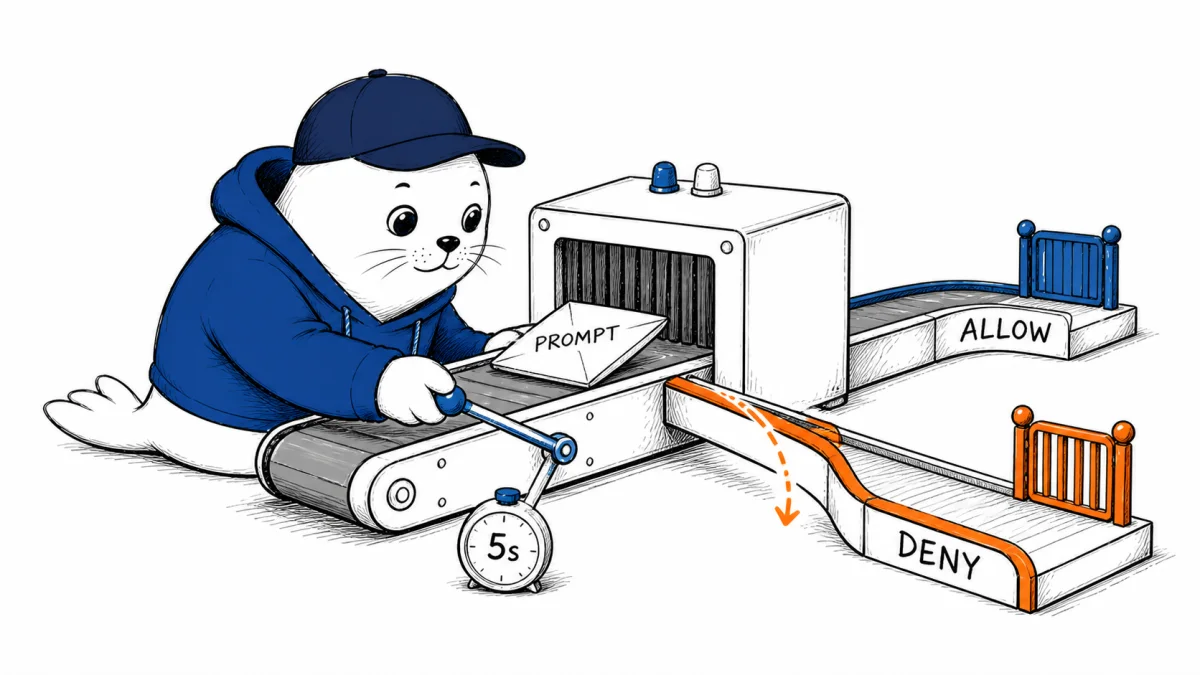
A policy endpoint can stop a request before inference. Its own availability and failure rules become part of the service your users depend on.
Inference Hooks are now out of beta
Anthropic’s October 20 release notes confirm that Enterprise organizations can now use Inference Hooks without beta status. Its current guide describes two events: prompt and tool_call.
The prompt event runs before governed inference. The tool_call event requires the Validate tool calls setting. Its verdict covers all tool calls in that response before they run.
This revises the earlier prompt-only description. Check the current configuration before assuming that a deployed endpoint inspects tool execution.
Match the verdict to the material received
The security server receives transcript text, tool calls and results, and text extracted from attachments. Raw file and image bytes are excluded. System prompts and Anthropic-internal context are also excluded.
A denied request does not reach the model. The hook can enforce an allow-or-deny decision on the material it receives, but visual content absent from the payload needs another control.
Keep policy-server logs and retention under review. The payload can contain sensitive conversation material even when the endpoint is running in shadow mode.
Test the failure rule and recovery
Anthropic describes a default verdict timeout of five seconds. When the endpoint fails or times out, the configured failure rule either blocks the request or lets it continue without inspection.
Sustained endpoint failures can trip a circuit breaker. The current guide says it resets automatically once Anthropic detects verdicts returning. This replaces the earlier description requiring manual recovery.
I would run a bounded failure drill with authorized test material. Record which requests are inspected, which follow the failure rule, and when inspection resumes. Confirm the outcome in endpoint and application records.
Start with observed traffic
Shadow mode collects verdicts without blocking users. Percentage rollout and role exclusions can also leave some traffic uninspected. Define the intended coverage before interpreting a successful test.
- Verify signatures before trusting inbound hook requests.
- Measure endpoint latency with representative transcript sizes.
- Check a controlled allow and deny result.
- Test tool-call validation separately when enabled.
- Record the behavior during a timeout and recovery.
Use a harmless denial case to check the user recovery path. Because later requests include conversation history, sending a corrected new message may still repeat the denied material.
Know which interface your policy governs
Inference Hooks govern supported Claude Enterprise requests. The Claude Platform API, Compliance API, and user-profile attribution serve different purposes and have different scopes.
Ask the administrator to confirm surfaces, exclusions, and enforcement settings. A product announcement cannot establish that every request in your organization is covered.
The user-profile guide covers end-customer API attribution. Our Compliance API article covers a separate record-access interface.
Read the sources and choose your next check
What evidence would confirm that inspection resumed after your policy endpoint recovered?
Checked October 21, 2026. This article is based on source review and analysis. Suggested tests have not been performed by MustHave.ai.