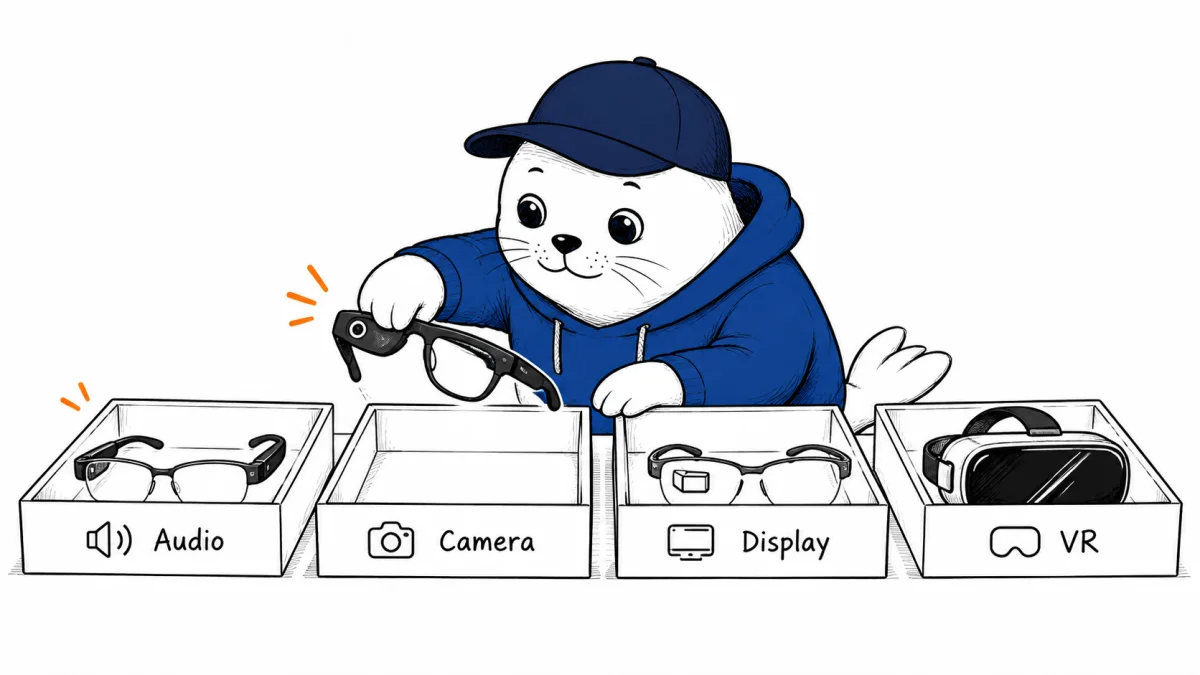
Meta’s September 2026 glasses announcements do not describe one device with four names. They span an audio-first pair, camera-equipped Ray-Bans, glasses with an in-lens display, and a tethered VR system due next year. The practical buying question is which capability you need on your face, and which announcement is actually available where you live.
The short answer: four different jobs
Meta’s September 23 product announcement puts Ray-Ban Meta Audio at the lightest, simplest end of the range. It prioritizes listening, calls, and voice assistance. Ray-Ban Meta Gen 3 adds a 12 MP camera and 3K video. Meta Ray-Ban Display puts information in view, while the separate Meta VR Glasses announcement describes a spatial screen, passthrough and an external compute puck. Treat the VR pair as a future product, not a currently shippable upgrade.
Meta AI glasses comparison at a glance
| Product | Primary use | US starting price reported by Meta | Status on September 24 |
|---|---|---|---|
| Ray-Ban Meta Audio | Audio, calls and voice AI without a camera-first pitch | $349 | Preorder; ships October 13 |
| Ray-Ban Meta Gen 3 | Hands-free photos, 3K video, audio and AI | $449 | Available |
| Meta Ray-Ban Display | Heads-up information and on-glasses interactions | Check local store | Available or rolling out by market |
| Meta VR Glasses | Immersive media, workspace and VR | $1,299.99 | Planned for spring 2027 |
The table is a decision aid, not a lab comparison. Meta has published different specifications and launch terms for each line, so a battery figure for one pair should not be read as a like-for-like endurance test against another.
Ray-Ban Meta Audio: the lighter entry point
At 43 grams, Meta says Ray-Ban Meta Audio can run for up to 12 hours on one charge, with up to 48 additional hours from its case. Advertised uses include music, podcasts, calls, and hands-free AI. Two styles, Clubmaster and Burbank, come in 23 color and lens combinations. Preorders began September 23 at $349 in the US, with shipping scheduled for October 13. These are manufacturer claims and availability dates, not independent wear or battery-test results.
This is the clearest choice if you want open-ear Audio and occasional assistant use but do not need the new Gen 3 camera. Anyone expecting an in-lens screen should look elsewhere in the lineup.
Ray-Ban Meta Gen 3: the capture option
Gen 3 starts at $449 in the US and is available now, according to Meta. The company lists a 12 MP camera, 3K Ultra HD video, a customizable action button, up to nine hours of battery life, and a six-microphone array. Meta says that array reduces more than 90% of background noise; that is its own performance claim, and real-world results will depend on the environment. A capture LED signals photo or video recording to people nearby.
For a buyer comparing Audio and Gen 3, the meaningful price step is $100 at the listed US entry prices. The extra spend buys the camera system and capture workflow, not merely another frame design. Privacy etiquette also changes once a device can record people around you.
Meta Ray-Ban Display: an availability map, not one global launch
Meta’s Display update says online US orders began September 23. Canada and the UK began online ordering and retail sales that day. France, Italy and Germany entered progressive preorder windows, with online ordering and retail sales scheduled for October 13. Store and prescription options differ by country, so local checkout is more reliable than a single global availability claim.
Some of the headline software is also staged. Cycling and public-transit directions are due later in September in the US and Canada. WhatsApp Hologram calling is slated for early access in the US later this fall. The Explore app and mirrored phone notifications were described as upcoming. By contrast, the enhanced calendar functions were listed as available in English in the US. A new hardware sale does not mean every demonstrated feature is live on day one.
Meta VR Glasses: a separate computing category
The announced VR Glasses weigh about 100 grams, according to Meta, but shift compute, battery, and storage to a puck connected by an optical tether. The company describes micro-OLED panels, a 5K display, passthrough cameras, hand and eye interaction, and Meta AI integrated into the operating system. It lists up to three hours of high-resolution media playback from the puck battery. That is a materially different setup from all-day audio glasses.
Meta targets spring 2027 and $1,299.99 in the US. The advertised immersive films, sports and workspace functions should be judged again near retail launch, when supported apps, regional access and independent testing are clearer.
Where Muse fits, and what remains unproven
Meta also said it is bringing its Muse personal AI agent to AI glasses. That is a platform direction across devices, not evidence that every advertised agent workflow is already available on every pair. We previously covered Muse’s proposed actions and payment workflows; buyers should separately check the current feature list, region, and permissions for the exact glasses they choose. The same availability discipline applies to other assistants, as our Siri AI feature guide explains for Apple’s ecosystem.
Bottom line: buy Audio for unobtrusive voice and sound, Gen 3 for hands-free capture, Display for heads-up information where it is sold, and wait for VR Glasses if immersive computing is the requirement. None is a universal replacement for the others.