Google and the Gates Foundation have announced more than $100 million in combined support for AI-powered climate, agriculture and language tools, with a stated goal of reaching 200 million smallholder farmers.
The headline is a roadmap, not a completed deployment
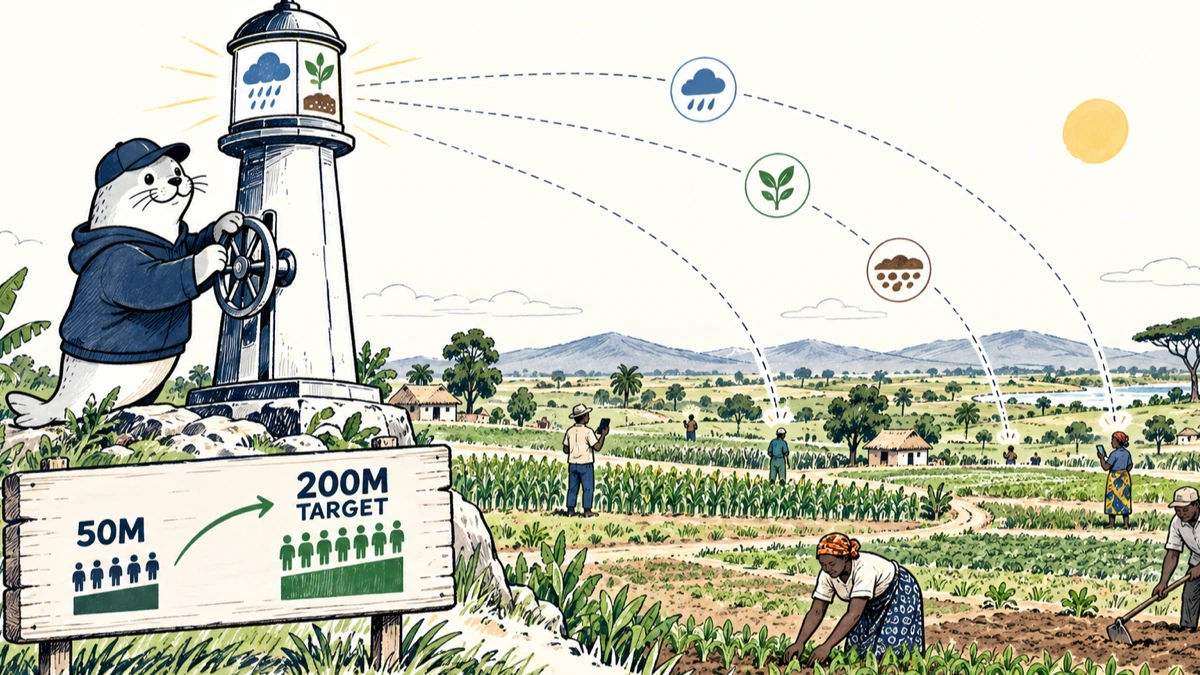
The initiative for AI tools for 200 million farmers is multi-year. The organizations say it will scale from an initial reach of 50 million farmers toward 200 million across Sub-Saharan Africa and South Asia. The $100 million figure combines funding with dedicated technical support from Google researchers.
Those numbers are confirmed as announced commitments and targets by both parties. They should not be reported as 200 million active users or $100 million already disbursed to farmers. Reach, repeated use and measurable benefit are different milestones.
Four delivery layers connect research to farms
| Layer | Named mechanism | What it is meant to do |
|---|---|---|
| Local ecosystems | Support for organizations including Wadhwani AI and Digital Green | Keep implementation, talent, governance and intellectual property connected to the regions served |
| Micro-climate guidance | TomorrowNow platform | Translate advanced forecasts into practical farm-level decisions |
| Field and crop mapping | Agricultural Understanding Platform | Map boundaries and monitor crops using imagery and AI |
| Language access | Localized information services and partners | Deliver advice in forms and languages farmers can use |
Why smallholder mapping is an infrastructure problem
The partners say small and irregular fields are difficult to identify with conventional satellite workflows. That affects access to weather alerts, insurance, credit, subsidies and government programs. Google’s Agricultural Understanding Platform is described as a foundation-model suite for mapping field boundaries and monitoring crops.
The announcement says the Agricultural Land Use data layer covers India, Malaysia, Vietnam and Indonesia, with deployments underway in Kenya, Uganda, Ghana, Rwanda, Zambia and Nigeria. Deployment underway is not the same as complete national coverage or proven farmer benefit.
What meaningful reach should measure
- Farmers who received at least one message.
- Farmers who understood and used the advice.
- Advice delivered before the relevant planting or weather decision.
- Accuracy by location, crop, season and language.
- Changes in yield, avoided loss, income or input cost.
- False alerts, missed events and channels for correction.
- Who controls farm data and whether participation affects eligibility for services.
A single reach number can hide large differences between a delivered notification and a decision that improves resilience. Public reporting should separate those stages.
The most important governance questions
Agricultural data can influence loans, insurance and government assistance. Field-boundary or crop errors therefore have consequences beyond an inaccurate recommendation. Farmers need to know what data is collected, who can reuse it, how long it is retained and how to challenge a wrong classification.
Local ownership also needs measurable terms. Funding a regional organization is useful, but data rights, model adaptation, procurement power and long-term operating budgets determine whether capacity remains after a grant ends.
A scorecard for the 50M-to-200M expansion
- Publish annual active-user counts by country and delivery channel.
- Report forecast and crop-advice accuracy under local conditions.
- Measure comprehension and adoption in each supported language.
- Track yield, income and loss outcomes with comparison groups where feasible.
- Record data-governance agreements and farmer complaint mechanisms.
- Disclose funding recipients, amounts, milestones and continuation plans.
- Invite independent evaluation of high-impact programs.
Where this fits in the wider AI-access debate
The program is a reminder that useful AI infrastructure can be forecasting, mapping and local-language delivery rather than a general chatbot. MustHave.ai’s coverage of AI for underrepresented languages shows why access depends on local data and evaluation. Our Maroc IA 2030 analysis similarly separates targets and presented systems from operating outcomes.
The practical verdict
The collaboration is significant because it combines funding, research support, climate infrastructure, agricultural mapping and local delivery partners. Its credibility will depend on transparent country-level measurement. The 200 million figure is an ambition; the public-interest test is whether farmers receive timely, accurate advice and retain meaningful control over the data used to produce it.
A credible public scorecard would report reach by country and language, the share of recommendations delivered before a decision deadline, observed error rates, adoption after advice, and outcomes split by crop and farm size. It should also publish how farmers can correct records or opt out. Without those measures, distribution counts can look impressive while hiding late forecasts, inaccessible delivery channels or advice that does not transfer to local conditions.
Primary sources
- Gates Foundation and Google joint release
- Google.org partnership announcement
- Google Agricultural Understanding Platform
Checked September 23, 2026. Funding, reach and impact figures are organization-reported. The 200 million figure is a future target, not a completed outcome.