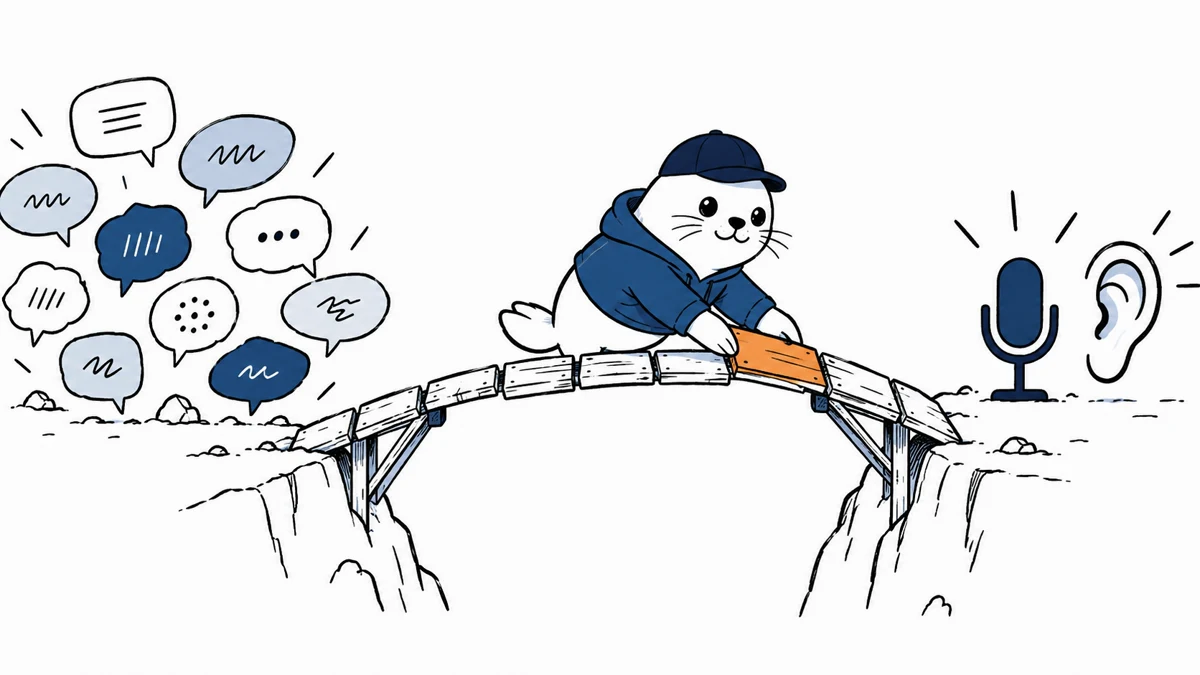
Sixty organizations announced a five-year goal on September 21, 2026: help people who speak languages underrepresented in today’s AI systems use those tools in their own language and voice.
The AI language coalition includes frontier model developers, governments, research groups, nonprofits and funders. Its announcement estimates that 3.4 billion people speak languages currently underrepresented in AI models. That number describes the target population, not people already reached. Detailed governance and workstreams will be designed over the coming year.
Who signed the commitment
The initial list includes Anthropic, Google, Microsoft, Mistral, NVIDIA, OpenAI Foundation, ElevenLabs, Mozilla Data Collective, UNICEF, the World Bank Group, national ministries, universities and community-led language organizations. This mix is important because model developers alone cannot create trustworthy language systems without speakers, local institutions and public-service experts.
A signature does not establish a common budget, technical architecture or binding delivery obligation. The announcement says participating organizations will contribute according to their expertise and capabilities.
The four work areas
| Work area | Intended output | Hard question |
|---|---|---|
| Open language layer | Reusable data and tools under open licenses | Who can consent to community-language data use? |
| Benchmarks | Tests for language and voice performance | Do scores cover dialect, code-switching and high-stakes meaning? |
| Models and applications | Systems useful in local services | Can communities operate them at affordable cost? |
| Governance | Privacy, consent and data-sovereignty practices | Who decides access, removal and commercial reuse? |
Voice is not a secondary feature
Text interfaces assume that people can type comfortably in a supported script and that digital spelling conventions are stable. Voice can be more practical where literacy, keyboard availability or local orthography creates friction. It also introduces new risks: accents may be misrecognized, speaker recordings can reveal identity, and a transcript can erase tone or cultural context.
A useful benchmark must therefore test more than word error rate. It should measure whether the system preserves names, numbers, medical or agricultural terms, negation and local expressions. Results should be reported by dialect and use case rather than collapsed into one language average.
Data sovereignty is the central implementation test
Opening language datasets can accelerate research, but some recordings, stories and community knowledge should not become unrestricted training material. Governance needs contributor consent, provenance, withdrawal procedures, access tiers and clear rules for commercial reuse. National ownership claims also should not erase the authority of the communities that generated the data.
This concern connects directly to regional infrastructure. Our analysis of Morocco’s JAZARI and Maroc IA 2030 implementation explains how language capability, local hosting and sovereign governance can become one policy question rather than three separate projects.
Milestones that would turn the goal into evidence
- Publish the governance structure, decision rights and conflict process.
- Name the first languages and explain how communities selected them.
- Release dataset cards with consent, provenance and license terms.
- Publish speech and text benchmarks with dialect-level results.
- Document safety evaluation for health, education and public-service use.
- Measure latency and cost on devices and networks used by target communities.
- Report the number of active users separately from the population that could benefit.
- Fund long-term maintenance rather than one-time data collection.
What the five-year goal does not yet include
The announcement does not state a central funding total, a language-by-language delivery schedule or enforcement mechanism. Its detailed structure, governance and workstreams are expected to be developed during the next year. Coverage should therefore describe a joint commitment and shared goal, not a completed deployment or a guaranteed benefit for 3.4 billion people.
Progress reporting should distinguish resources from outcomes. Hours of recorded speech, number of datasets and model-download counts are useful production measures, but they do not show whether people receive accurate help in their preferred language. The coalition should publish task-level results for real services, disclose error differences across dialects and record complaints or harmful failures. Community organizations need authority to challenge a benchmark that rewards fluent output while missing local meaning. Without that feedback loop, a large open dataset can expand model coverage without producing dependable access.
For developers, the practical comparison should include small and regional models as well as frontier systems. Our reference guide to useful AI repositories offers starting points for speech, translation, evaluation and local deployment work.
Primary source
Checked September 22, 2026. The 3.4 billion figure is an estimated target population, not a usage result.