
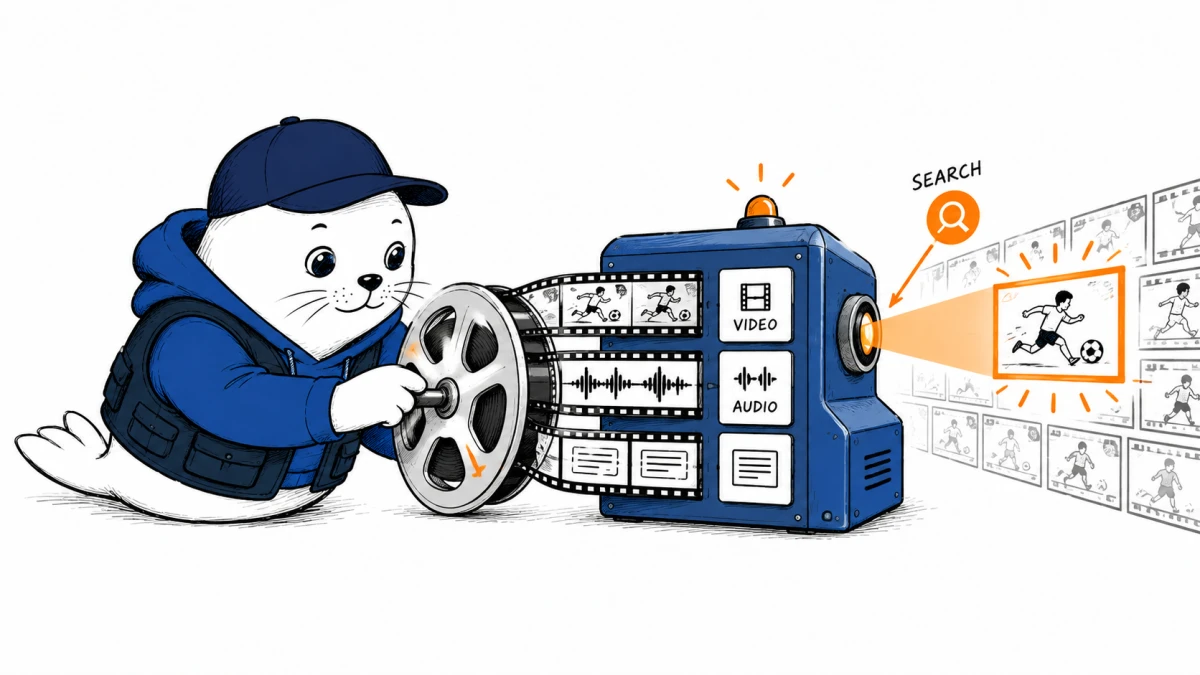
Search a video archive for “the penalty kick in the second half” and the hard part is not the sentence. It is keeping frames, speech, sound, timestamps and vectors aligned well enough to return the right moment.
AWS announced general availability of TwelveLabs Marengo Embed 3.0 in Amazon Bedrock Knowledge Bases on September 10, 2026. The integration turns Amazon Bedrock video search into a managed ingestion and retrieval path for video, audio, images and text.
The old pipeline had five places to drift
- Split the video into meaningful time segments.
- Sample frames without losing the relevant action.
- Transcribe speech and preserve timestamps.
- Embed each modality into a searchable representation.
- Write vectors and metadata to an index that can return the original clip.
A custom stack can do all of this, but every join is a potential failure. Change the segment duration and the transcript boundaries may no longer match the frames. Rebuild the index and source timestamps can go stale. The operational burden grows faster than the demo suggests.
The managed version removes the stitching
Managed Knowledge Bases accepts MP4 and MOV video, JPEG and PNG images, and audio tracks. AWS says it handles segmentation, frame sampling and transcription internally. During synchronization it extracts frames, transcribes audio, generates embeddings for each segment and writes the vectors to the index.
Marengo Embed 3.0 represents video, audio, images and text in the same 512-dimensional vector space. A natural-language query can therefore retrieve a segment using visual action, spoken content or sound rather than relying only on filenames and manually written tags.
What comes back is a moment, not just a file
In AWS’s walkthrough, a ten-minute World Cup clip is queried for penalty kicks. Results include a source URI, chunk start time, chunk end time and embedding type. That metadata is what makes the search result usable: an application can jump to the relevant interval rather than hand the user an entire match.
The downstream interface is the Bedrock Retrieve API. It can feed a media-search application directly or become a retrieval target for an agent. This connects naturally with our analysis of agentic video processing, where the trace must prove which parts of a video the model actually inspected.
What the service still leaves to you
- Rights: confirm that each media asset can be indexed and exposed to the intended users.
- Access control: keep retrieval permissions aligned with the source system.
- Evaluation: build a query set with exact expected time ranges, not only subjective relevance.
- Retention: define what happens when a source file is removed or replaced.
- Cost: measure ingestion, vector storage, retrieval and model invocation together.
Managed infrastructure reduces pipeline ownership. It does not decide whether a retrieved clip is authorized, complete or safe to show.
A useful evaluation looks like an archive test
Create 50 questions across visual action, spoken phrases, background audio and combinations of the three. Mark the correct video and time window before running the system. Score top-one and top-five retrieval, timestamp overlap and false positives from visually similar scenes. Repeat after changing the default four-second segmentation window.
For production, add permission tests: a user who cannot open a source video should not receive its transcript, thumbnail or semantic summary. Our Avid browser and Gemini agents analysis covers the neighboring question of how creative media work moves into browser-based agent workflows.
Availability is narrow at launch
Managed Knowledge Bases with Marengo Embed 3.0 is available in US East, Northern Virginia, and US West, Northern California. AWS says customers pay for storage and retrieval, while embedding generation uses the standard Bedrock model invocation rate. Teams outside those regions should check data-residency and transfer constraints before designing around the service.
My take: the disappearing glue code is the real launch
The model’s 512-dimensional representation is technically interesting. The product shift is more practical: AWS is absorbing the fragile synchronization work between media preprocessing and retrieval. That can turn semantic video search from a bespoke pipeline into a service configuration. The buyer’s job then moves upward, toward access rules, relevance evaluation and archive economics.
Primary sources
- AWS Marengo 3.0 Knowledge Bases announcement and walkthrough
- Amazon Bedrock Knowledge Bases documentation
Checked September 13, 2026. Capabilities, regions and service behavior are attributed to AWS. MustHave.ai has not independently tested retrieval quality.