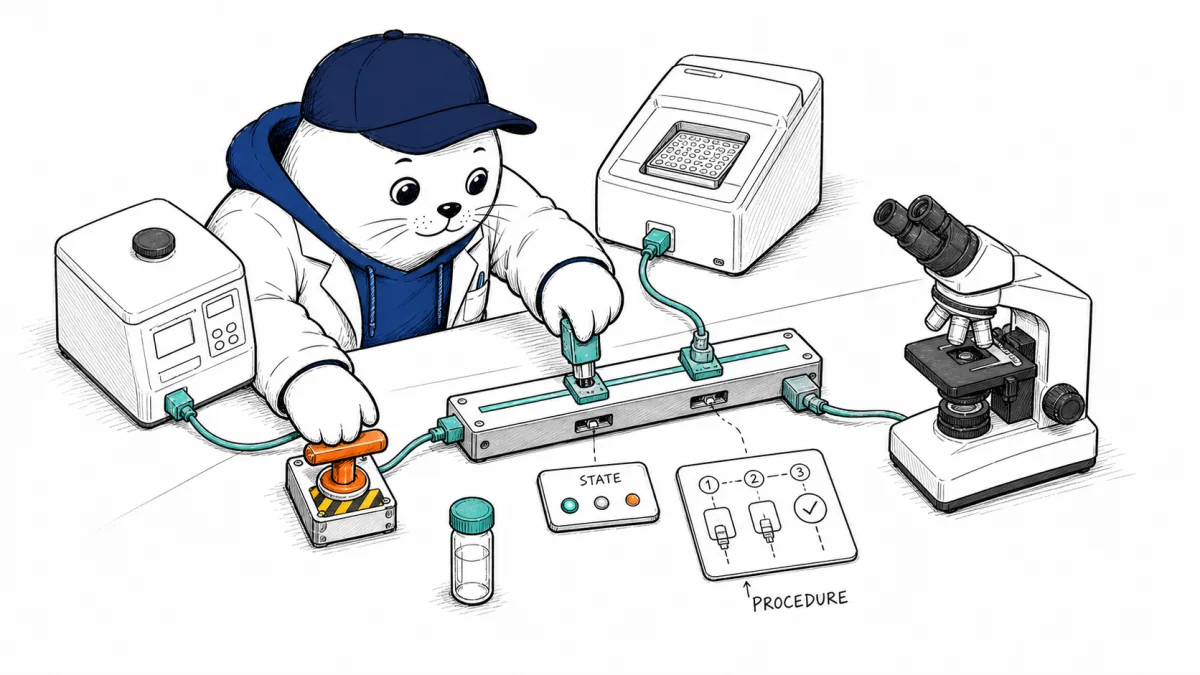
Giving an AI agent a laboratory is easy to describe and hard to wire. Every instrument speaks its own dialect, carries physical limits, and can ruin a sample long before a chatbot notices anything went wrong.
Anthropic’s Model Hardware Standard, or MHS, is an attempt to give programmable laboratory and manufacturing devices a shared interface. An agent can discover what a device is, inspect its current state, and call named procedures without learning a fresh vendor API for every instrument.
The comparison with Model Context Protocol is useful but incomplete. MCP connects models to software tools and data. MHS aims at physical equipment, where a malformed command can waste material, contaminate a run, or move machinery in the wrong state.
MHS separates device state from procedures
Anthropic describes a model-agnostic specification built around two practical questions: what is the device doing now, and what approved operations can it perform? That is more useful than exposing a bag of low-level controls and expecting the agent to infer a safe sequence.
A liquid handler, microscope, incubator, or plate reader can publish a consistent description of its state and procedures. The agent can then work through a common layer while device-specific adapters handle the underlying commands.
This is where MHS resembles MCP architecturally: both turn an opaque integration into discoverable tools with structured inputs. The physical boundary makes MHS less forgiving. A browser action can often be cancelled or repeated. A biological sample may not offer a second attempt.
The early integrations are promising, not universal benchmarks
Anthropic’s research-preview announcement names work with Genentech, Carnegie Mellon University, the University of Washington, HHMI Janelia, AWS, Hugging Face, and Raspberry Pi.
| Reported integration | Result | What it does not prove |
|---|---|---|
| Six instruments | Connected in under one week | That every instrument family is equally easy to adapt |
| Carnegie Mellon setup | About eight hours instead of several weeks | A controlled industry-wide integration average |
| Experimental workflow | Roughly three times faster | Universal scientific productivity or autonomous safety |
These numbers are useful because they describe real integrations. They remain proof-of-concept results reported by Anthropic and its partners. Different instruments, drivers, calibration routines, and safety procedures can change the work dramatically.
The standard is not open source yet
MHS is a research preview. Anthropic has not released it as an open standard with a public conformance suite, neutral governance body, and a mature ecosystem of independently maintained adapters.
That affects the “standard” label. Builders can evaluate the direction and the partner evidence, but they cannot yet treat MHS like a stable procurement requirement. A lab that adopts the preview should keep the adapter boundary replaceable and preserve its own device-control layer.
- Keep device drivers independent from the agent prompt.
- Version every procedure schema and adapter.
- Record who approved each callable operation.
- Require a safe state when the agent, network, or adapter stops responding.
- Export run logs in a format that survives a future standards change.
Discovery should not imply permission
A device can advertise a procedure without giving every agent permission to run it. Discovery, authorization, validation, and execution should remain separate gates.
I would assign each procedure a risk class. Reading a temperature may run automatically. Moving a stage near a fragile sample may require current calibration. Dispensing a costly reagent or opening a pressure path should require a human confirmation tied to the exact device state.
This is the physical version of the permission problem in Claude Code cross-session messaging: a clean interface can make authority feel safer than it is. The control needs to live below the conversation, where the device adapter can refuse an unsafe call.
Build an interlock stack before adding autonomy
A useful MHS evaluation should start with a boring workflow that experts already understand. Connect one read-only instrument, compare the agent’s interpretation with the existing control software, and log every state transition.
- Expose observation before actuation.
- Define allowed procedures rather than raw motor or valve commands.
- Validate units, ranges, calibration state, sample identity, and prerequisites below the model.
- Require confirmation for irreversible or expensive steps.
- Test loss of network, stale state, duplicate calls, partial completion, and emergency stop.
- Have a domain expert review the run trace and the physical outcome.
Our report on AI evaluations that reached real systems offers the relevant warning: written scope does not protect anything when the infrastructure still permits the action.
The economic value is adapter reuse
The exciting part of MHS is not a robot scientist pressing buttons. It is the possibility that a device integration can be reused across models, workflows, and institutions. If one adapter exposes a stable procedure layer, teams can change the planner without rewriting every instrument connection.
That value disappears if schemas are vague or every lab forks the protocol. The preview needs public versioning, test fixtures, capability negotiation, error semantics, safety-state behavior, and independent implementations before buyers can measure portability.
My verdict: test the interface, keep the expert at the boundary
MHS addresses a real bottleneck. Agents cannot become useful laboratory operators if every device requires a custom prompt, private script, and one engineer who remembers the setup.
The research preview is enough to justify a controlled pilot, not enough to justify unattended physical autonomy. Start read-only, make procedures narrow, and keep device-level interlocks independent of the model. The shared interface should reduce integration work without becoming a shared bypass around laboratory judgment.
Read the source record
- Read Anthropic’s Model Hardware Standard research preview.
- Compare Ars Technica’s independent overview.
- Review Musthave.ai’s Anthropic risk-report analysis before treating an agent interface as an oversight system.
AI systems may connect to laboratory workflows, but every candidate still faces human clinical evidence requirements. The Enveda AI drug discovery funding report maps those stages.
Checked August 29, 2026. Integration times and workflow-speed claims are reported by Anthropic and participating organizations. MHS remains a research preview and is not presented here as an open, finalized industry standard.