

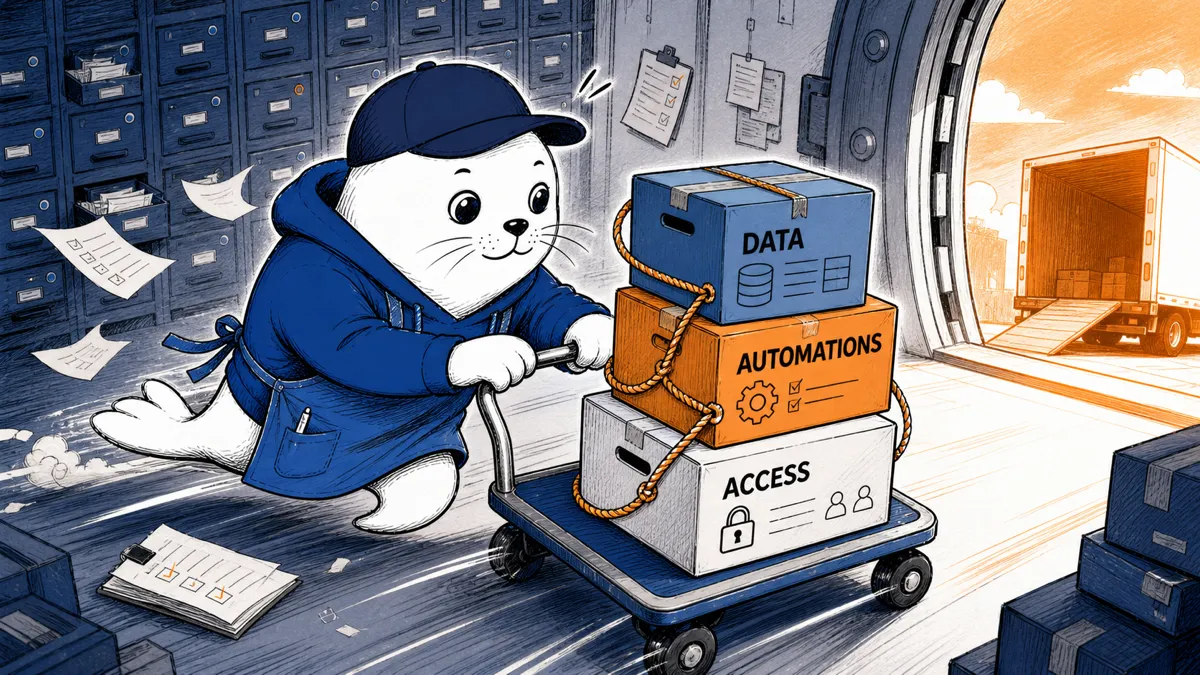
The Airtable acquisition is not a reason to export everything in a panic. It is a reason to discover whether “we can leave anytime” is actually true.
Bending Spoons agreed to acquire Airtable for $1.29 billion in cash, according to reporting published August 4. Including Airtable’s cash and equivalents, the transaction implies an equity value of about $2.25 billion. The agreement still has to close, and no customer pricing or product changes were announced with it.
For customers, the urgent question is smaller and more practical: if Airtable changed price, packaging, support, or product direction, how much of your operation could you rebuild elsewhere?
Airtable’s valuation path
Financing values and the acquisition’s implied equity value are not perfectly comparable, but the distance is instructive.
- 2021 pre-money: $11.0B
- 2026 implied equity: $2.25B
- Cash purchase: $1.29B
The $2.25B implied equity value is about 79.5% below the $11B 2021 pre-money valuation. Different capital structures and deal terms make this a directional comparison.
What the Airtable acquisition changes today
Legally, an agreement is not the same as a completed acquisition. Operationally, customers should not assume an immediate change. Airtable still runs the product, your contracts still apply, and speculation is not a release note.
What did change is the probability of future product decisions coming from a new owner. Bending Spoons has acquired and operated a growing portfolio of software products. That does not tell us what it will do with Airtable, but it makes dependency mapping a sensible job now rather than after a pricing email.
The acquisition price also tells a broader SaaS story. Airtable announced a $735 million round in December 2021 at an $11 billion pre-money valuation. The current transaction’s implied equity value is far lower. A great product can still meet a different capital market.
Your rows are not your whole system
Airtable lets users download a view as CSV. That is useful, but a CSV preserves a flat table, not the complete behavior of a base. Linked records may become values. Automations, scripts, interfaces, forms, field rules, syncs, extensions, and permission logic need separate documentation.
What a flat export can miss
Inventory these layers before you call a backup complete.
- Structure: Linked relationships, formulas, field types, views, and filters.
- Behavior: Automations, scripts, integrations, forms, and interfaces.
- Control: Owners, editors, guests, tokens, service accounts, and access rules.
I have seen teams say their data was backed up because they had a spreadsheet. When they tried to rebuild, the missing piece was the workflow: who receives the notification, what creates the task, which record is linked, and who is allowed to change it.
Run a recovery test, not an export ritual
Pick one workflow that would hurt if it stopped: content production, client onboarding, inventory, recruiting, or support. Export its data. Then rebuild enough of it in a neutral format or another system to complete one real transaction.
The five-part portability check
You are ready only when each answer is specific.
- Data: Can we export every critical table and attachment?
- Relationships: Can we recreate links and formulas without guessing?
- Automation: Do we have triggers, actions, scripts, and credentials documented?
- Access: Can we rebuild roles without exposing sensitive records?
- Recovery: Has another person restored one workflow successfully?
- Time: Do we know the hours and manual work a move would take?
This exercise is useful even if you never leave Airtable. It exposes undocumented logic, owner-only automations, expired tokens, and fragile workarounds. It also gives you a better basis for comparing tools than a feature grid.
Do not migrate before the facts arrive
A rushed migration can create more risk than an ownership change. Wait for concrete information about closing, terms, pricing, support, product investment, and data handling. At the same time, reduce the cost of your next decision.
For each critical base, assign an owner, record the external integrations, export data on a schedule, and save the recovery instructions somewhere outside Airtable. If an automation spends money or messages a customer, add a manual fallback.
That is the same discipline I recommend when evaluating AI tools for real freelance work: judge the workflow, not the demo. And if agents are beginning to operate your database, our guide to what agentic AI actually means explains why permissions and recovery matter.
My read: portability is leverage
The Airtable acquisition may lead to better investment, worse packaging, or very little visible change. We do not know yet. A tested exit path makes all three outcomes easier to handle.
Portability is not disloyalty. It is negotiating power and operational hygiene. If the product remains a strong fit, stay because it earns the job. If the fit changes, you should be able to move because you prepared before the deadline was real.
Go deeper
- Read the report on Bending Spoons’ Airtable agreement.
- Review Airtable’s official base permissions documentation.
- Use Airtable’s data import guide to understand what a rebuild requires.
- Read Airtable’s 2021 Series E announcement for the earlier valuation context.
Reporting checked August 5, 2026. Deal values come from the announced agreement and cited reporting; the transaction had not been described here as closed.