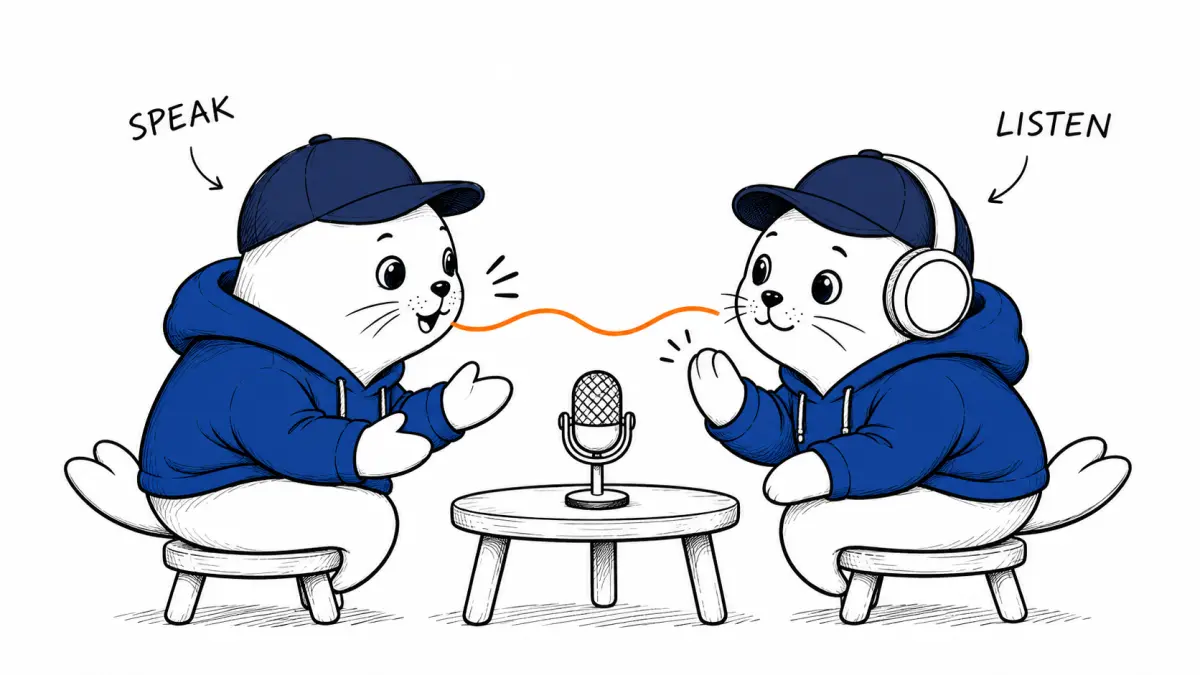
A conversational avatar can answer your question correctly and still make the exchange awkward by speaking before you finish.
Emma is Nuance Labs’ audiovisual AI persona, introduced on November 9, 2026. She uses Nuplex 1.0 to combine speech with facial behavior during a conversation. Visitors can find the browser experience through Nuance’s public entry point; developers have a separate beta platform.
The practical appeal is conversational timing. For a founder considering an avatar, a realistic face alone cannot establish whether the experience helps a visitor. The person needs room to hesitate, correct a detail, and understand the response.
This is a source-based evaluation guide, not a hands-on review. MustHave.ai did not start a microphone or camera session. The test below is a proposed method readers can use within the service’s rules.
Begin with the actual access limits
Nuance’s launch announcement describes an English-only, adult-only experience. It acknowledges interruptions, timing errors, reasoning mistakes, and occasional visual glitches. Those limits belong alongside any demonstration of a natural exchange.
The announcement also restricts cloning and identifies healthcare and uses involving minors as outside the beta. API video carries an AI watermark. A consumer conversation and an approved commercial application therefore need different planning.
Before testing, decide whether your intended audience fits the available language and age boundaries. A product demo for an international English-speaking audience can be relevant. A classroom deployment for children would conflict with the announced scope.
Check the live access screen instead of assuming a video circulating on social media proves availability for your account. A public demonstration shows that someone recorded an interaction under specific conditions. It does not establish your region, account allowance, or API entitlement.
Give the conversation one measurable purpose
A small evaluation could ask whether a visitor can understand a fictional app’s purpose after a brief exchange. Use harmless sample facts: an app organizes reading notes, has a free trial, and exports plain text. Do not supply real customer records.
Write the desired outcome before the session. For example, the listener should be able to name the app’s task and explain what to try first. That outcome is easier to assess than whether the avatar seemed human.
Keep the same facts for each attempt. If you change the product, speaking style, and network conditions at the same time, a smoother second conversation can have several possible explanations. A short fixed script helps you compare observations fairly.
For a personal evaluation, you can keep simple notes about your experience. Publishing recordings or transcripts introduces separate permission questions. Confirm the applicable terms before creating a public review or a monetized demonstration.
A proposed conversation test that checks recovery
The following sequence tests ordinary conversation behavior without trying to provoke prohibited output. It has no pass rate because we have not run it.
| Situation | Sample input | Observation to record |
|---|---|---|
| A pause inside a sentence | “The app is for people who collect notes … from books.” | Did the response start before the thought was complete? |
| A factual correction | “I said ten days, but the trial is fourteen days.” | Did the next answer use the corrected duration? |
| A clarification | “Explain that without assuming I know the product.” | Did the explanation become easier to follow? |
| An uncertain answer | “Which of those details did I leave unspecified?” | Did the answer identify a gap or invent a fact? |
Record an observation immediately after each exchange. “Interrupted twice during the pause exercise” is more useful than “felt less natural.” It also lets you distinguish a pleasant manner from a reliable explanation.
Allow a correction without changing the acceptance standard halfway through. An avatar that initially mishears a trial length but uses the correction may be suitable for one task. Repeating the wrong price after a correction would matter more in a buying conversation.
Separate delivery quality from answer quality
Use two columns in your notes. One describes the exchange: pauses, overlap, and whether the response arrives at an appropriate moment. The other describes the content: correct facts, relevant answer, and clear limits.
Consider a hypothetical comparison. Session A feels natural but repeats the wrong trial length. Session B has an awkward pause but preserves every product fact. Neither observation alone settles which experience suits a public product page.
For that use, I would require factual accuracy first. Conversational polish can make a correct explanation easier to hear. It can also make an incorrect explanation sound more persuasive, which increases the cost of missing the error.
Don’t turn a small personal test into a general benchmark. If you try four exchanges, report four exchanges and describe the conditions. A percentage without a meaningful sample and a consistent definition can imply much more certainty than the exercise provides.
Read the recording rules before planning a creator format
Nuance’s consumer terms say exported interaction clips are for personal, noncommercial use. They also describe processing of audiovisual data and account-dependent consent choices. A founder should review those provisions before putting private business material into a conversation.
The acceptable-use policy separately restricts commercial captures, misleading edits, and removal of AI disclosures. It describes exceptions for applications only to the extent permitted by the developer agreement. A popular creator’s upload does not grant you the same rights.
For a commercial plan, identify exactly what you want to distribute: a screenshot, a transcript, a video advertisement, or an interactive application. Ask the provider which agreement covers that deliverable. Keep the reply with your project records.
This changes a production decision. Someone exploring conversational behavior personally can start with the consumer experience. A business promising customers an embedded avatar needs to resolve API access, permitted use, and support before advertising the feature.
Estimate the work around a public deployment
A useful budget includes time to write approved facts, check changed information, and respond when the conversation fails. Treat these as proposed operating tasks; this article does not establish that Emma supplies any particular integration or support feature.
For an illustrative pilot, imagine twenty sample conversations. If each needs three minutes of review, inspection alone takes an hour. Correcting the source instructions and repeating failed cases adds more time. These are planning assumptions, not measured Emma performance.
The exercise is worthwhile when it answers a business question. Can visitors choose the right next step with less confusion? If an ordinary text explanation already does that well, the avatar needs a specific additional benefit to justify the maintenance.
Try the experience before promising a product feature
Begin at the official browser entry point and read the current access terms. Keep a first personal session small and non-sensitive. Developers can inspect Nuance’s separate platform before deciding whether to pursue an application.
Our business-automation guide applies the same discipline to delegated work: define the finished result and decide who reviews it. For an avatar, also decide how the visitor recovers when a response is incomplete.
Would a conversational face solve a real problem for your visitors, and what observation would convince you that it does?

Abdessalam Alaoui
I'm Abdessalam Alaoui, founder of Musthave.AI. I write practical guides to AI models, tools, generative media.